Palermo Travel Guide: Sights, Markets & Street Food
A Guide to Palermo: Art, Markets, Street Food and Authentic Sicily
October 26, 2026Il Team Seesily13 min read
Palermo is a city that overwhelms the senses: a labyrinth of Arab-Norman alleyways, noisy and fragrant markets, and one of Italy's richest street food traditions. From the majestic Cappella Palatina to the steaming stalls of Ballarò, Sicily's capital holds centuries of history woven together by Arab, Norman, Byzantine and Spanish cultures. This guide takes you to discover the most authentic Palermo: UNESCO monuments, legendary street food, outstanding museums and the secrets of each neighbourhood.
Palermo: the Sicilian capital that never stops surprising
Palermo is a city that does not lend itself to easy description. Chaotic and magnificent, noisy and silent in its hidden cloisters, fragrant with spices and the sea, the capital of Sicily is one of the most fascinating and complex places in the Mediterranean. Founded by the Phoenicians, conquered by the Carthaginians, the Romans, the Arabs, the Normans, the Swabians and the Spanish, Palermo carries in its DNA millennia of cultural crossings that can still be read today in its monuments, its cuisine, and the character of its inhabitants.
Walking through the historic centre means crossing layers of overlapping civilisations: a mosque turned into a church, a Norman palace with Byzantine mosaics, a market that seems to have stepped out of a North African medina. Palermo is not a city to visit in a hurry: it must be lived, savoured, allowed to get under your skin. This guide is the starting point for doing so in the best possible way.
The Arab-Norman UNESCO Monuments
In 2015, UNESCO inscribed "Arab-Norman Palermo and the Cathedral Churches of Cefalù and Monreale" on the World Heritage List, a serial site comprising nine extraordinary architectural structures. These buildings, constructed between the 9th and 12th centuries, represent the unique synthesis of Arab, Byzantine and Norman cultures that made Palermo one of the most brilliant courts in medieval Europe.
Palermo Cathedral
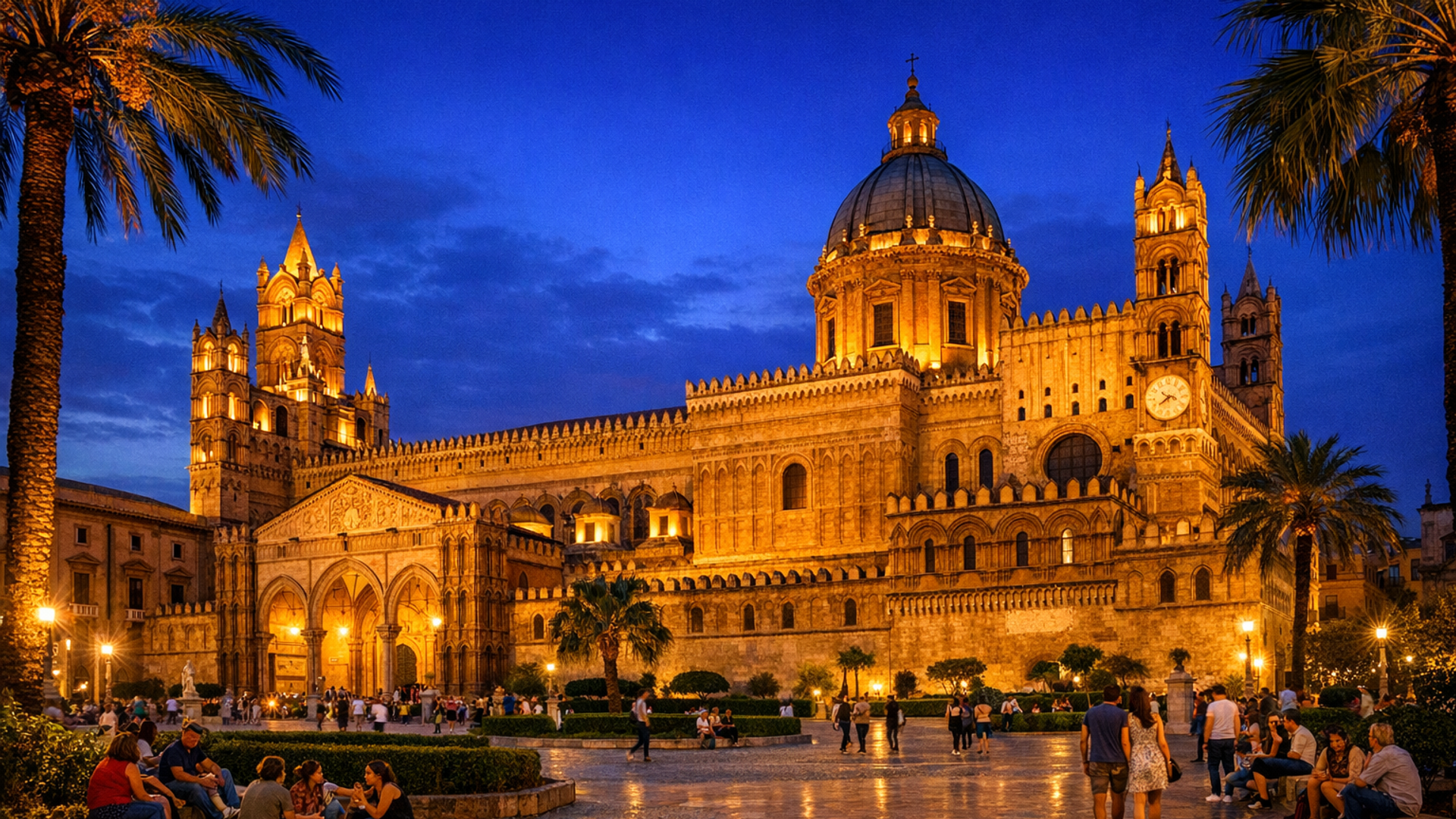
Palermo Cathedral is one of the city's most iconic monuments, a building that tells centuries of history and transformation on its own. Built in 1185 on an Arab mosque — which in turn stood on an early Christian basilica — the cathedral underwent numerous interventions over the centuries that altered its appearance, making it a fascinating architectural palimpsest. The Gothic-Catalan façade, the bell towers, the domes added in the eighteenth century and the fourteenth-century portico coexist in an ensemble that, while not stylistically homogeneous, possesses an irresistible charm.
Inside are the tombs of the Norman kings and Swabian emperors, including Frederick II of Swabia, one of the most extraordinary rulers of the Middle Ages. Do not miss the climb to the rooftops, from which you can enjoy a breathtaking panoramic view over Palermo's rooftops and Monte Pellegrino.
Palazzo dei Normanni and the Cappella Palatina
The Palazzo dei Normanni — today the seat of the Sicilian Regional Assembly — is the oldest royal palace in Europe still in use. Built by the Arabs in the 9th century and expanded by the Normans in the 12th, the palace houses within it one of the absolute masterpieces of medieval art in the world: the Cappella Palatina.
Commissioned by Roger II and consecrated in 1143, the Cappella Palatina is an explosion of beauty that takes your breath away. The inlaid marble floor, the wooden muqarnas ceiling painted by Arab craftsmen, and the golden mosaics covering every centimetre of the walls create an effect of luxury and spirituality without equal. The mosaics, created by Byzantine craftsmen, depict scenes from the Old and New Testaments with extraordinary vividness and precision. The Cappella Palatina is, simply, one of the most beautiful places in Italy.
Chiesa della Martorana
Facing the splendid Piazza Bellini, the Church of Santa Maria dell'Ammiraglio — universally known as the Martorana — is another jewel of the Norman period. Founded in 1143 by Admiral George of Antioch, the church preserves some of the oldest and best-preserved Byzantine mosaics in Sicily. Particularly celebrated is the mosaic depicting Roger II crowned by Christ, an image of extraordinary symbolic and artistic power.
The church owes its popular name to the Benedictine convent founded beside it by Eloisa Martorana in 1194. It was the nuns of this convent who invented the frutta martorana, sweets made of marzipan moulded into the shape of fruit, still one of the symbols of Sicilian confectionery today.
San Giovanni degli Eremiti
Not far from the Palazzo dei Normanni, San Giovanni degli Eremiti is perhaps the most evocative monument in all of Palermo. Its five red domes — an unmistakable symbol of the city — stand out against the blue sky with a grace that seems suspended between East and West. Built in 1136 at the behest of Roger II on a pre-existing Arab mosque, the church is today deconsecrated and open to visitors as a museum.
But the true treasure of San Giovanni degli Eremiti is the cloister: a paradisiacal garden with round arches, paired columns and a lush vegetation of palms, citrus trees and flowers. Sitting here, in the silence of the afternoon, is one of the most magical moments Palermo can offer.
Historic Markets and Street Food
If the monuments tell the history of Palermo, the markets reveal its living, pulsating soul. The city's three great historic markets — Ballarò, Vucciria and Capo — are far more than simple places of commerce: they are open-air theatres where Palermitan life unfolds with all its energy, noise, colours and aromas.
Ballarò, Vucciria and Capo: the markets of the soul
Ballarò is the largest and oldest of Palermo's markets, a labyrinth of stalls winding through the Albergheria and Capo neighbourhoods. Everything is sold here: freshly landed fish, brightly coloured vegetables, fragrant spices, meat, cheeses, olives and every kind of local produce. Vendors shout prices in thick dialect, colourful carts line up alongside improvised stalls, and the air is thick with overlapping smells — fish, frying, citrus, mint — that form an unmistakable and unforgettable scent.
La Vucciria is the most famous market, immortalised by Renato Guttuso's 1974 painting. Today it is less lively as a food market than it once was, but in the evening it transforms into one of the city's most animated gathering places, with bars, fry shops and music echoing through the alleyways of the Mandamento Castellammare.
Il Capo stretches along Via Sant'Agostino and is perhaps the most authentic and least touristy of the three. Here Palermitans really come to do their shopping, and the atmosphere is that of a lived-in, genuine neighbourhood market.
Street food: a unique gastronomic heritage
Palermo is universally recognised as one of the world's street food capitals, and that is no exaggeration. Palermitan street cuisine has its roots in the Arab tradition and in the poor cooking of the working-class neighbourhoods, and has produced a series of specialities unmatched in any other Italian city.
Le arancine (feminine, in Palermo!) are the queens of Sicilian street food: spheres of golden, crispy rice filled with meat ragù or butter and ham, fried to perfection. Every rosticceria has its own secret recipe, and the debate over which is the best is a matter of civic identity.
Le panelle are chickpea flour fritters, thin and crispy, often served in a soft bread roll with or without potato crocchè. Simple, inexpensive and extraordinarily good, they are the perfect snack to eat while strolling through the market.
Il pane ca' meusa — literally "bread with spleen" — is the most characteristic and divisive street food in Palermo. Veal spleen is boiled and then fried in lard, and served in a soft roll with or without ricotta and caciocavallo. It is a strong, bold, absolutely authentic flavour: loving or hating it is inevitable, but tasting it is compulsory.
Lo sfincione is Palermitan pizza: thick, soft, topped with tomato sauce, onion, anchovies, caciocavallo and oregano. Sold by the slice from carts in the streets, it is the ultimate comfort food for Palermitans.
Le stigghiole are lamb or kid offal wrapped around spring onions and grilled over charcoal. The aroma they give off is unmistakable and can be smelled from a distance: following your nose is the best way to find them.
I crocchè (or cazzilli) are potato croquettes flavoured with mint and parsley, fried and served piping hot. Crispy on the outside and incredibly soft inside, they are irresistible.
Museums and Culture
Palermo is not just markets and street food: the city is home to some of the most important museums in southern Italy, with collections ranging from classical antiquity to medieval and modern art.
Museo Archeologico Regionale Antonio Salinas
The Salinas Museum, housed in the former convent of Sant'Ignazio all'Olivella, is one of the most important archaeological museums in Italy. Its collections include Phoenician, Greek, Roman and Punic artefacts from across Sicily, with a section dedicated to the metopes from the temples of Selinunte of extraordinary beauty and historical importance. The metopes — limestone bas-reliefs that decorated the pediments of the temples — are among the masterpieces of archaic Greek sculpture and are alone a sufficient reason to visit the museum.
Galleria Regionale della Sicilia — Palazzo Abatellis
Housed in the magnificent Palazzo Abatellis, a 15th-century Gothic-Catalan building, the Galleria Regionale della Sicilia holds one of the most important collections of medieval and Renaissance art in southern Italy. The most celebrated piece is the "Triumph of Death", a 15th-century fresco by an unknown author depicting death astride a skeletal horse indiscriminately mowing down rich and poor alike: a work of extraordinary visual power. The gallery also houses the bust of Eleanor of Aragon by Francesco Laurana and numerous works by Sicilian painters from the Middle Ages to the seventeenth century.
Teatro Massimo
The Teatro Massimo in Palermo is the largest opera house in Italy and the third largest in Europe by size, after the Paris Opéra and the Vienna Staatsoper. Inaugurated in 1897 after twenty years of construction, the theatre is a masterpiece of Italian neoclassicism designed by architect Giovan Battista Filippo Basile and completed by his son Ernesto. Its monumental staircase, Corinthian columns and green dome have become one of the symbols of Palermo. Attending a performance at the Teatro Massimo is an unforgettable experience: the acoustics are exceptional and the atmosphere is that of the great Italian operatic tradition.
Day Trips
Palermo is an excellent base for exploring the surrounding area, rich in natural and artistic treasures that perfectly complement a visit to the city.
Monreale and the golden mosaics
Just 8 kilometres from Palermo, perched on the hills overlooking the Conca d'Oro, Monreale is home to one of the greatest masterpieces of medieval art in the world: the Duomo di Monreale. Commissioned by William II in 1174, the cathedral is entirely covered in golden mosaics spanning a surface area of over 6,000 square metres, narrating the stories of the Old and New Testaments with a wealth of detail and a dazzling luminosity. The Christ Pantocrator dominating the central apse, with his stern and merciful gaze, is one of the most powerful images in medieval Christian art. Do not miss the Benedictine cloister, with its 228 paired columns decorated with mosaics and sculptures of extraordinary variety.
Mondello: the beach of the Palermitans
About twenty minutes from the centre of Palermo, nestled between Monte Pellegrino and Monte Gallo, Mondello is the beach par excellence for Palermitans. Its very fine white sand, crystal-clear sea and the characteristic Art Nouveau bathing establishment built on stilts are the perfect setting for a day of relaxation. In summer Mondello comes alive: colourful parasols, children playing, the scent of sunscreen and lemon granita. The seafront is dotted with kiosks where you can enjoy local specialities: granitas, brioche, seasonal fruit.
Cefalù
About 70 kilometres east of Palermo, Cefalù is one of Sicily's most beautiful villages and one of the island's most beloved tourist destinations. Its medieval historic centre, dominated by the imposing Rocca and the magnificent 12th-century Norman Cathedral, slopes gently down to the sea through a maze of alleyways, small squares and honey-coloured houses. The cathedral of Cefalù, with its Byzantine mosaics and the Christ Pantocrator of the apse, is part of the same UNESCO site as Palermo and Monreale. Cefalù's beach, with its golden sand and clear waters, is among the most beautiful on Sicily's northern coast.
The Conca d'Oro
The Conca d'Oro — literally "golden basin" — is the fertile plain surrounding Palermo, once entirely covered in citrus groves that perfumed the air for kilometres around. Much reduced today by urban expansion, the Conca d'Oro still preserves corners of extraordinary beauty, with lemon and orange gardens, historic villas and panoramic views over the city and the sea. A walk or a bicycle ride through the surviving citrus groves is an experience that offers a different and more intimate perspective on the city.
Practical Tips
How to get to Palermo
Palermo is well connected to the rest of Italy and Europe. By plane, the Falcone-Borsellino International Airport at Punta Raisi is located about 35 kilometres from the city centre and is served by numerous airlines with direct flights from Milan, Rome, Turin, Bologna and many other Italian and European cities. From the airport, the Trinacria Express — a direct train — connects the airport to Palermo Central Station in about 50 minutes. By ferry, Palermo can be reached from Naples, Genoa, Civitavecchia and Cagliari with overnight ferries offering comfortable cabins: a romantic and practical way to arrive in Sicily.
Getting around the city
Palermo's historic centre is relatively compact and many of the main monuments can be reached on foot. For longer distances, the city has an urban bus network managed by AMAT and an expanding tram line. Taxis are easily found in the main squares. Renting a bicycle or a scooter is an excellent option for exploring the city with greater freedom, but care must be taken with the traffic, which can be chaotic. We strongly advise against renting a car to move around within the historic centre.
Neighbourhoods to stay in
The Mandamento Castellammare and the Mandamento Monte di Pietà — the two neighbourhoods that make up the heart of the historic centre — are the ideal choice for those who want to be a stone's throw from the main monuments, markets and restaurants. The Kalsa neighbourhood, once the Arab quarter of the city, is today one of the most vibrant and creative, with art galleries, fashionable venues and a buzzing artistic community. For those who prefer a quieter, more residential atmosphere, the Politeama and Libertà neighbourhoods offer good-quality hotels, restaurants and shops just minutes from the centre.
When to visit Palermo
Palermo is a destination that lends itself to visiting at any time of year, but the best months are April, May, June, September and October, when the climate is mild and pleasant, the days are long and the city is not yet (or no longer) overwhelmed by summer tourism. July and August are the hottest and most crowded months, but also offer the greatest nightlife and the opportunity to enjoy the beaches. Winter is mild compared to the rest of Italy and allows you to visit the monuments without queues, although some tourist services may be reduced.
The Festino di Santa Rosalia
Every year on 15 July, Palermo celebrates its patron saint Santa Rosalia with the Festino di Santa Rosalia, one of the most spectacular and heartfelt religious festivals in Italy. The celebration commemorates 1625, when the relics of the saint were carried in procession through the streets of the city to free it from the plague. Today the Festino is a mass event involving the entire city: a monumental float tens of metres high travels along the Cassaro — Palermo's main thoroughfare — amid fireworks, music, a festive crowd and an authentic and moving popular devotion. If you have the opportunity to be in Palermo on 15 July, do not miss it for any reason: it is an experience you will not easily forget.
Plan Your Trip to Palermo
Let AI create a personalized itinerary for Palermo