A Guide to Syracuse: Ortigia, the Greeks, and the Ionian Sea
October 31, 2026Il Team Seesily10 min read
Founded by the Greeks and celebrated by Cicero, Syracuse holds millennia of history among timeless temples and theatres. Ortigia, its ancient island, is a labyrinth of baroque alleyways and the scent of orange blossom that seems to stop time itself. And then there is the sea — the most beautiful in Sicily — embracing everything with a golden, unrepeatable light.
Introduction
Once upon a time, on the eastern shores of Sicily, there was a city so great and so powerful that it rivalled Athens itself. It was called Syracuse, and its name echoed throughout the ancient Mediterranean as a byword for splendour, ingenuity, and beauty. Founded in 734 BC by Corinthian colonists led by Archias, it grew to become the most populous metropolis in the Greek western world — a city of marble, philosophy, war, and art.
Here Archimedes was born, the genius who moved the world with a lever and defended the city with war machines that left the Romans dumbfounded. Here Cicero, governor of Sicily, sought and found the tomb of Archimedes among the brambles, and wrote of Syracuse with moved admiration. Here Plato attempted — in vain — to educate a tyrant in philosophy. Here the Greeks built one of the largest theatres of the ancient world, still alive and pulsing beneath the Sicilian sky today.
Syracuse is a layered city, like a millennial cake: Greek in its foundations, Roman in its stones, Arab in its perfumes, Norman in its churches, baroque in its facades. Every civilisation has left its mark without erasing the one before, creating a palimpsest of history unmatched in Italy. Coming to Syracuse is not tourism: it is a journey through time.
Ortigia: The Island of Suspended Time
Ortigia is the ancient heart of Syracuse, an island connected to the mainland by two bridges, small enough to walk across in an hour, large enough to get lost in for days. The moment you cross the bridge, the noise of the modern world fades, and you enter another dimension — that of suspended time, where the alleyways smell of jasmine and the stones tell stories three thousand years old.
The most extraordinary monument in Ortigia is the Cathedral of Syracuse, one of the most singular churches in Europe. It is not simply built on top of a Greek temple: it is the Greek temple — the Temple of Athena from the 5th century BC — transformed into a Christian cathedral in the 7th century AD. The original Doric columns are still there, embedded in the lateral walls, visible from both inside and outside — a two-thousand-year embrace between paganism and Christianity that takes your breath away.
Facing the Cathedral opens Piazza del Duomo, considered one of the most beautiful baroque squares in Italy. Paved in pale stone, flanked by honey-coloured eighteenth-century palaces, animated by cafés and restaurants, it is the drawing room of Syracuse — the place where the city gathers, shows itself, tells its story. At sunset, when the raking light gilds the facades and swallows trace arabesques in the sky, it is simply perfect.
A few steps from the Cathedral lies the Fonte Aretusa, a freshwater spring that wells up directly by the sea — a hydrogeological miracle that the Greeks explained through myth. Arethusa was a nymph from Elis, pursued by the river god Alpheus; to escape him, Artemis transformed her into a spring, and she fled beneath the sea to re-emerge here, in Ortigia. Today the spring is a small lake surrounded by Egyptian papyrus and wild ducks, a corner of poetic quiet at the heart of the island.
At the southern tip of Ortigia stands Castello Maniace, a Swabian fortress of the 13th century built by Frederick II of Swabia at the furthest point of the island. From here the view over the Porto Grande and the open sea is breathtaking — especially at dawn, when the sun rises from the sea and tints everything orange and gold.
In the heart of Ortigia hides the Giudecca, the ancient Jewish quarter, one of the oldest in Europe. Here, beneath a medieval palace, a mikveh was discovered — a Jewish ritual bath — dating to the 4th–5th century AD, among the oldest and best-preserved in the world. A visit to the mikveh is a silent and moving experience, an encounter with a vanished community that left indelible traces in the stone.
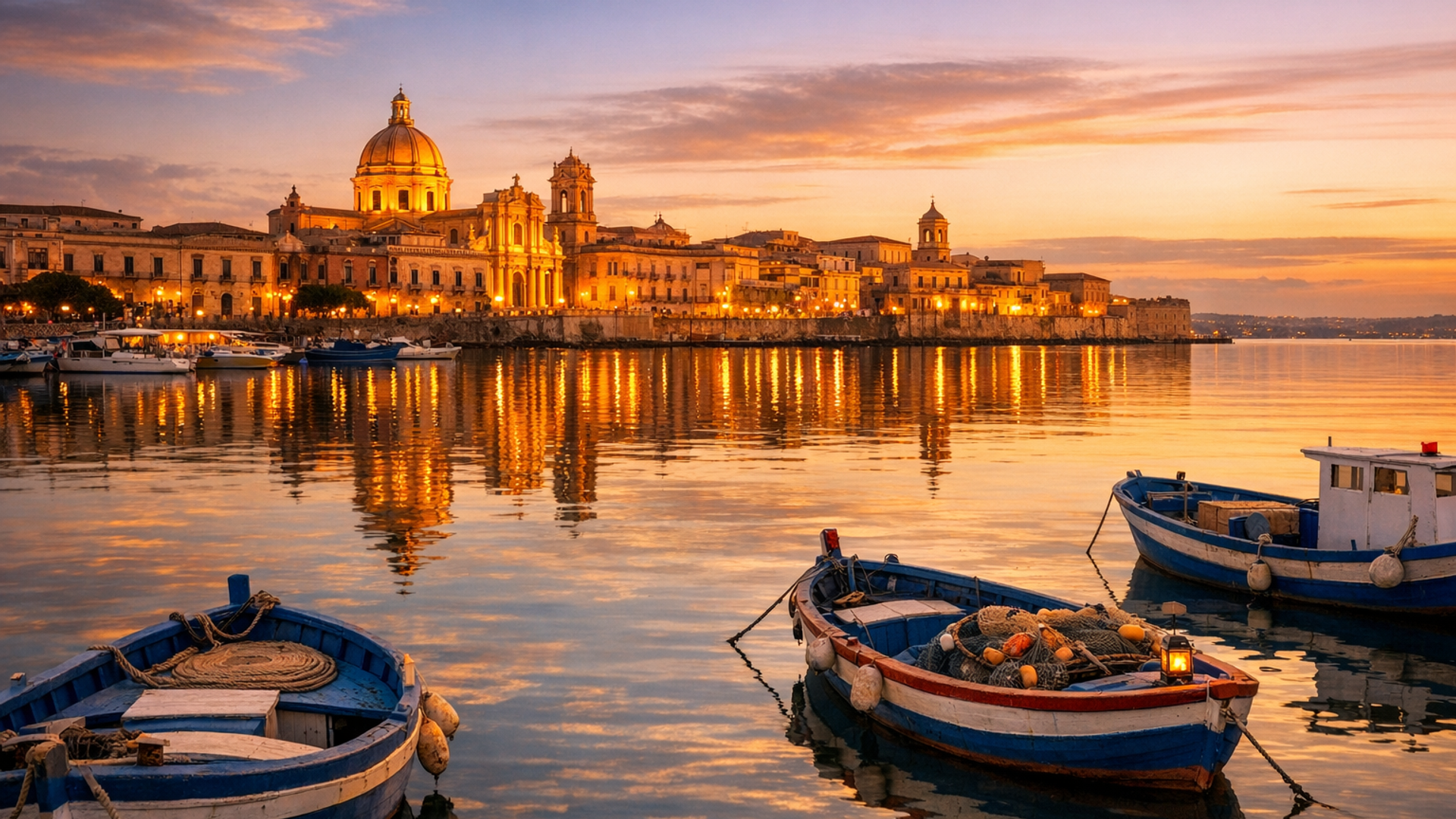
In the evening, the Ortigia seafront transforms into the stage for the Syracusan aperitivo. You sit on the low walls overlooking the harbour, with a glass of Nero d'Avola or an Aperol spritz, as the sun slowly descends toward the horizon and the sky turns pink and violet. It is one of those moments you carry inside you forever.
The Neapolis Archaeological Park
A few kilometres from the centre of Syracuse, on the mainland, stretches the Neapolis Archaeological Park — one of the most important and evocative archaeological sites in the Mediterranean. Here, among pines and olive trees, stand the monuments that tell of the greatness of Greek and Roman Syracuse.
The jewel of the park is the Greek Theatre, carved directly into the living rock of the Temenite hill in the 5th century BC. With a cavea of 67 rows of steps capable of holding up to 15,000 spectators, it is one of the largest and best-preserved Greek theatres in the world. The most extraordinary thing is that it is not a museum piece: every summer, from May to June, the theatre comes back to life with the Greek Theatre Festival, staging the tragedies of Aeschylus, Sophocles, and Euripides in the very place where they were performed two thousand five hundred years ago. Attending a performance here, beneath the Sicilian stars, is an experience that redefines the meaning of theatre.
Beside the theatre open the Latomie del Paradiso, the ancient limestone quarries from which the blocks to build the city were extracted. Today they are shady, silent gardens, with rock walls tens of metres high covered in ivy and maidenhair fern — places of a melancholy and almost supernatural beauty. Here the Athenian prisoners were imprisoned after the disastrous expedition of 413 BC, and here many died of hardship.
Within the Latomie opens the Ear of Dionysius, an artificial cave shaped like an ear, 23 metres high and 65 metres long, with extraordinary acoustics: a whisper inside is transformed into an amplified echo that resonates throughout the cavity. Legend has it that the tyrant Dionysius I used this cave as a prison, listening from above to the conversations of the inmates. Whether true or not, the story adds a shiver to the visit.
The park also hosts the Roman Amphitheatre of the 3rd century AD, one of the largest in Sicily, and the Altar of Hiero II, a gigantic altar of the 3rd century BC measuring 198 metres in length — the largest altar in the ancient world — where public sacrifices were held in honour of the gods.
The Surroundings of Syracuse
Syracuse is an ideal starting point for exploring one of the most beautiful corners of eastern Sicily. To the north of the city, the Simeto River Oasis Nature Reserve offers a landscape of dunes, lagoons, and Mediterranean scrub where flamingos and grey herons nest — a surprising contrast with the ancient stone of the city.
Heading south, the Syracusan coast opens into a sequence of coves and golden sandy beaches that culminates in the magnificent Plemmirio Marine Reserve, a few kilometres from the centre. The waters of Plemmirio are among the clearest and most marine-life-rich in Sicily: posidonia seabeds, underwater caves, octopuses, and groupers. With a mask and snorkel — or on a guided dive — it is possible to explore an underwater world of rare beauty.
A boat tour of the Porto Grande is an unmissable experience: seen from the water, the silhouette of Ortigia with its towers and domes takes on an almost unreal dimension, like a floating city suspended between sky and sea. Tours depart from the harbour and last about an hour, with the possibility of swimming in the harbour waters.
Just 30 kilometres to the west, Noto — the capital of Sicilian baroque, a UNESCO World Heritage Site — deserves a half-day visit. Its main street, Corso Vittorio Emanuele, is a triumph of honey-coloured stone and sculpted facades that at sunset seem to burn with their own light. Together with Ragusa Ibla and Modica, it forms the triangle of Iblean baroque, one of the most extraordinary architectural landscapes in Europe.
Syracusan Flavours: Eating and Drinking
Syracuse is savoured with the eyes before the mouth. The Ortigia market, held every morning between Via Trento and the Fonte Aretusa, is a spectacle of colours, scents, and voices: stalls of freshly caught fish, brightly coloured vegetables, cheeses, olives, spices. It is the right place to understand what it means to eat in Sicily.
The day begins with granita and brioche — the quintessential Sicilian morning ritual. In Syracuse the granitas are of exceptional quality: almond, lemon, black mulberry, coffee. The brioche, soft and fragrant, is dipped into the granita with an ancient and irresistible gesture.
At lunch, pasta alla Norma — rigatoni with fried aubergine, tomato, basil, and salted ricotta — is the emblematic dish of eastern Sicilian cuisine. Arancini (or arancine, depending on the province) are the street food par excellence: balls of fried rice filled with ragù, peas, and mozzarella, crispy on the outside and creamy within.
Fish is the absolute protagonist of Syracusan cuisine: sarde a beccafico, polpo alla luciana, spada alla ghiotta, Mazara red prawns raw with a drizzle of oil and lemon. The best restaurants are found in the alleyways of Ortigia, away from the most touristy squares.
To finish, a mulberry granita — the most Syracusan flavour of all — or an almond sweet, accompanied by a glass of Moscato di Siracusa, one of the oldest sweet wines in the world, already cited by Pliny the Elder. Or a local Nero d'Avola, robust and fragrant, perfect with aged cheeses.
Practical Information
Getting there. Syracuse can be reached by train from Catania in about 1 hour and 20 minutes — a scenic journey along the Ionian coast that is already part of the experience. From Palermo the train takes about 3 and a half hours. By car, Syracuse is reached from the A18 motorway (Catania–Syracuse) in about 1 hour from Catania. Bus connections with the main Sicilian cities are also available.
Getting around the city. Ortigia is almost entirely pedestrianised: cars are largely prohibited, and this is one of its most precious gifts. You move on foot, slowly, getting lost in the alleyways. The Neapolis Archaeological Park can be reached by taxi or urban bus from the station.
When to go. Spring (April–May) and early autumn (September–October) are the ideal times: the climate is mild, the sea is already warm (or still warm), and tourist crowds are reduced. Summer is beautiful but hot and crowded. Winter is quiet and luminous, perfect for those who love the city without tourists.
The Greek Theatre Festival is held every year from May to June, with performances of Greek tragedies and comedies in the ancient theatre. Tickets must be purchased well in advance: it is one of the most moving cultural events in Italy.
Where to stay. Ortigia offers a wide choice of B&Bs, boutique hotels, and apartments in the historic centre — the best choice for experiencing the island in all its magic. Booking in advance is essential in high season. For those seeking more space and tranquillity, there are excellent agriturismi in the countryside around the city.
Syracuse is not forgotten. It is one of those cities that enters the soul and never leaves — like the scent of orange blossom carried on the wind, like the reflection of the sun on the sea of the Porto Grande, like the echo of an ancient voice in the Ear of Dionysius.
Plan Your Trip to Siracusa
Let AI create a personalized itinerary for Siracusa