Agrigento Guide: Valley of the Temples & Everything You Need to Know
October 6, 2026Il Team Seesily11 min read
Agrigento is one of Sicily's most captivating destinations, home to one of the most extraordinary legacies of ancient Greek civilisation: the Valley of the Temples, a UNESCO World Heritage Site and a timeless wonder. In this complete guide you'll discover the temples, the historic centre, the beaches, the surrounding natural landscapes, and everything you need to know to make the most of your visit. Let yourself be won over by a city that tells three thousand years of history amid silver olive groves and breathtaking sunsets.
Agrigento stands on a hilltop overlooking the Mediterranean, in the heart of southern Sicily, carrying with it the magnificent weight of three thousand years of history. Founded by the Greeks in the 6th century BC under the name Akragas, it became one of the most powerful and wealthy cities of the ancient world — so much so that the poet Pindar called it "the most beautiful city of mortals". Today, its most precious heritage is recognised by UNESCO as a World Heritage Site, attracting hundreds of thousands of visitors from around the world every year. Agrigento is not just archaeology: it is a place where past and present intertwine among medieval alleyways, the scent of orange blossom, and breathtaking views of the sea. If you are planning a trip to Sicily, Agrigento is an absolutely unmissable stop.
The Valley of the Temples
The Valley of the Temples is the beating heart of Agrigento and one of the most important and best-preserved archaeological sites in the world. It stretches across approximately 1,300 hectares along a hillside ridge to the south of the modern city, dotted with Doric temples, necropolises, gardens, and ancient walls. Walking among these monuments at sunset, when the golden light of the Sicilian sun bathes them in orange and gold, is an experience that stays with you forever.
Temple of Concordia
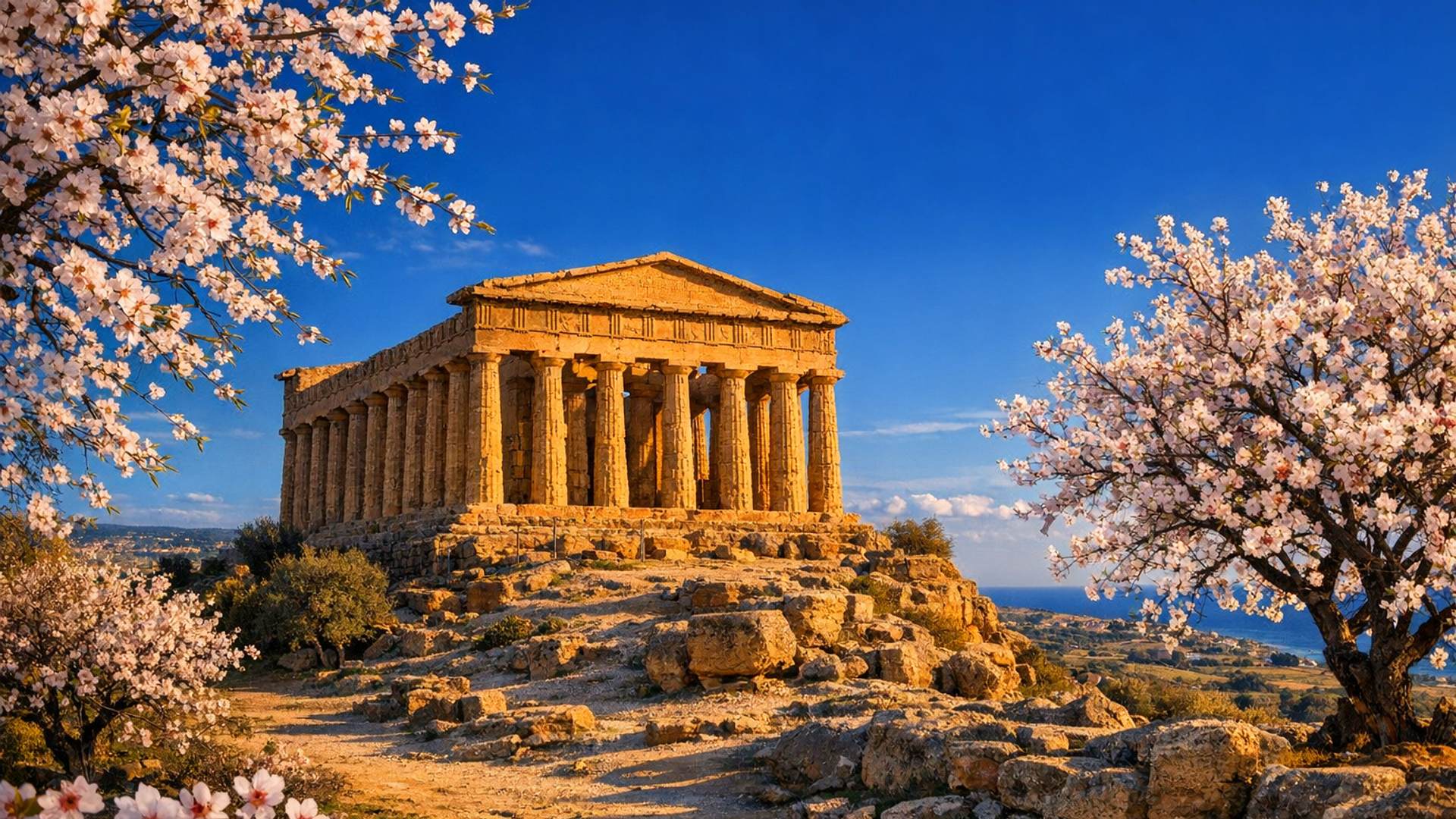
The Temple of Concordia is the absolute symbol of Agrigento and one of the best-preserved Greek temples in the world, second only to the Parthenon in Athens. Built around 440–430 BC, it owes its extraordinary integrity to its conversion into a Christian church in the 6th century AD, which preserved its load-bearing structure. The Doric colonnade — 34 fluted columns standing over six metres tall — still rises majestically against the blue sky, creating one of the most iconic panoramas in Sicily. Visit at dawn or sunset for spectacular light and smaller crowds. The interior of the temple is accessible and allows you to appreciate the architectural details up close.
Temple of Juno
Situated at the eastern end of the park, the Temple of Juno (or Hera Lacinia) offers one of the most beautiful panoramic views in the entire Valley. Built around 450 BC, it retains 30 of its original columns and still shows traces of burning dating back to the Carthaginian sack of 406 BC — a historical scar that makes the monument even more evocative. Its elevated position affords a breathtaking view over the surrounding countryside, the olive groves, and on clear days, all the way to the sea. It is the ideal starting point for a visit to the park, descending from there towards the Temple of Concordia.
Temple of Hercules
The Temple of Hercules is the oldest in the Valley, dating back to the late 6th century BC, and the first that visitors encounter when entering from the western side. Of its original 38 columns, only eight remain, reassembled in 1924 thanks to funding from the English captain Alexander Hardcastle. The ruins, precisely because of their incompleteness, exude a particularly romantic and melancholic charm: the column drums scattered among tall grass and almond bushes tell of the inexorable passage of time. It is one of the most photographed spots in the park, especially at sunset.
Kolymbetra Garden
Hidden in a small valley between the temples, the Kolymbetra Garden is a corner of paradise often overlooked by hurried visitors — and yet it absolutely deserves a stop. Managed by the FAI (Italian Environment Fund), this ancient irrigation garden dates back to the Greek era and today hosts an extraordinary variety of Mediterranean plants: citrus trees, olive trees, almond trees, carob trees, pomegranates, and lush wild vegetation. Strolling along its shaded paths, with the scent of citrus in the air and birdsong as a backdrop, is an experience of absolute peace. The garden has its own opening hours and requires a separate ticket (or is included in some FAI memberships).
Practical tips for your visit
The Valle dei Templi Archaeological Park is open every day, generally from 8:30 am until sunset (with seasonal variations). A full-price ticket costs around 12–15 euros and includes access to all the main temples; the Kolymbetra Garden has an additional ticket of around 5 euros. It is strongly recommended to purchase tickets online in advance, especially during high season (July–August), to avoid long queues. The best time to visit is early morning or late afternoon, both for the photographic light and for cooler temperatures. Guided tours — available in Italian, English, and other languages — are highly recommended for a full understanding of the history and architectural details of the monuments; many local agencies offer 2–3 hour tours with certified guides.
The City of Agrigento
Beyond the Valley of the Temples, the city of Agrigento deserves an in-depth visit to discover its fascinating historic centre, layered with Greek, Roman, Arab, Norman, and Baroque influences.
Historic Centre
The heart of the modern city is Via Atenea, the main street that runs through the historic centre from east to west, lined with historic buildings, shops, cafés, and restaurants. Wandering through its side alleys means immersing yourself in an authentic and lively atmosphere, far from mass tourist circuits. The squares — such as Piazza Pirandello, dedicated to the celebrated Agrigentine playwright — are gathering places for locals and offer picturesque views over the surrounding countryside.
Cathedral of San Gerlando
Dominating the historic centre from the top of its hill, the Cathedral of San Gerlando is one of the most important religious monuments in Agrigento. Founded in 1086 by the Norman Gerlando of Besançon, the city's first bishop, it was expanded and modified over the following centuries, acquiring Romanesque, Gothic, and Baroque elements that coexist in a surprising balance. The interior houses works of great artistic value, including frescoes, sculptures, and the Roman sarcophagus of Phaedra and Hippolytus. The unfinished bell tower is one of the most recognisable features of the city's skyline.
Arab-Norman Quarter
Agrigento preserves significant traces of its cultural layering in the quarter that bears the marks of Arab and Norman rule. Here, narrow and winding alleyways open onto hidden courtyards, rounded arches alternate with geometric decorations of clear Islamic inspiration, and small Norman churches hide among the houses. This quarter is the ideal place to wander without a plan, letting yourself be surprised at every turn. The fusion of different cultures — Greek, Roman, Arab, Norman — is what makes Agrigento a unique city in the Sicilian landscape.
The Surroundings of Agrigento
The surroundings of Agrigento offer natural landscapes of extraordinary beauty, which perfectly complement the cultural experience of the city.
Scala dei Turchi
About 15 km from Agrigento, the Scala dei Turchi is perhaps the most iconic natural landscape in southern Sicily. It is a cliff of white marl — a sedimentary rock smoothed by wind and sea — that descends in steps towards the sea with sinuous and almost surreal forms. The contrast between the dazzling white of the rock, the deep blue of the Mediterranean, and the green of the Mediterranean scrubland creates a panorama of absolute beauty. To reach it, you can park at Realmonte and walk a short path on foot. It is recommended to visit early in the morning to avoid summer crowds and enjoy the best light for photographs.
San Leone Beaches
San Leone is Agrigento's seaside resort, about 6 km from the city centre, and is the favourite beach destination for locals. The beach is long, sandy, and well-equipped with beach clubs, fish restaurants, and ice cream parlours. In summer the atmosphere is lively and family-friendly, with children playing at the water's edge and adults enjoying the shade of the gazebos. The San Leone seafront promenade is pleasant for an evening stroll, with numerous venues where you can enjoy an aperitivo or a Sicilian granita at sunset.
Torre Salsa Nature Reserve
About 30 km from Agrigento, the Torre Salsa Nature Reserve is a natural gem managed by the WWF. It extends over more than 700 hectares of cliffs, dunes, Mediterranean scrubland, and a wild and unspoilt beach, reachable only on foot along paths immersed in nature. The reserve is home to a rich fauna — herons, falcons, sea turtles that nest on the beach — and a highly varied Mediterranean flora. It is the ideal place for lovers of trekking and unspoilt nature, far from crowds and mass tourism. The paths are well marked and suitable for hikers of all levels.
Gastronomy and Local Specialities
A trip to Agrigento would not be complete without immersing yourself in the extraordinary Sicilian gastronomic tradition. Local cuisine is a reflection of the island's millennia-long history: Greek, Arab, Norman, Spanish — every domination has left its mark on the plate.
Sicilian Arancine
Arancine (feminine, as they are called in Palermo and throughout western Sicily) are one of the island's most beloved street foods. These fried rice balls, filled with meat ragù, peas, and mozzarella — or with butter and ham — are crispy on the outside and soft on the inside. In Agrigento you'll find them in rosticcerie and bars from the morning, perfect as a quick snack or an informal lunch.
Pasta con le Sarde
Pasta con le sarde is one of the signature dishes of Sicilian cuisine, with deep roots in the Arab tradition. It is made with fresh sardines, wild fennel, raisins, pine nuts, saffron, and toasted breadcrumbs — a perfect balance of sweet, savoury, and aromatic. It is a dish that tells the history of the island in every bite and one you cannot miss during your stay.
Cannoli
Sicilian cannoli are perhaps the most famous Italian dessert in the world. The fried and crispy pastry shell, filled with fresh sheep's ricotta worked with sugar and chocolate chips, is an absolute delight. In Agrigento and the surrounding area you'll find artisan pastry shops that prepare them to order, guaranteeing a freshness and quality that is hard to find elsewhere. Pair them with an espresso for an authentic experience.
Local Wines
Sicily is one of Italy's most interesting wine regions, and the province of Agrigento is no exception. Nero d'Avola is the king of Sicilian red wines: full-bodied, fruity, and with spicy notes, it pairs perfectly with meat dishes and aged cheeses. For whites, Grillo and Inzolia are native varieties that produce fresh, aromatic, and mineral wines, perfect with fish and seafood. Many wineries in the area offer tastings and guided tours — an excellent addition to your itinerary.
Practical Tips
How to Get There
Agrigento can be reached by car, train, or bus. By car, from the A19 Palermo–Catania motorway take the Agrigento exit and follow the SS640; from Palermo the journey takes about 2 hours, from Catania about 2.5 hours. By train, there are direct connections from Palermo (about 2 hours) and from Catania with a change at Caltanissetta; Agrigento Centrale station is in the heart of the city. By bus, the Cuffaro and Sais Trasporti companies offer frequent services from Palermo (about 2 hours) and from Catania (about 3.5 hours) at very affordable fares.
Best Time to Visit
The ideal time to visit Agrigento is spring (April–May) and autumn (September–October). In spring the countryside is green and in bloom, temperatures are mild (20–25°C), and crowds are still manageable. In autumn the summer heat eases, the light is golden, and the colours of the landscape are extraordinary. Summer (July–August) is the busiest and hottest season (up to 38–40°C), but also offers the chance to combine culture and the sea. Winter is quiet with few tourists, but some services may have reduced hours.
Valley of the Temples Ticketing
It is strongly recommended to purchase tickets for the Valle dei Templi Archaeological Park online in advance on the park's official website (valledeitempli.it). This allows you to avoid queues at the ticket office, especially in the summer months and at weekends. Full-price, reduced (for under-18s, over-65s, and students), and combined tickets with the Pietro Griffo Regional Archaeological Museum are available; the museum houses extraordinary finds from the Valley's excavations.
Guided Tours
To experience the Valley of the Temples in a richer and more meaningful way, a guided tour is the best choice. Certified local guides offer 2–3 hour tours in Italian, English, French, and German, with historical, mythological, and architectural insights that transform the visit into an unforgettable experience. Many hotels and B&Bs in the centre can recommend trusted guides, or you can book directly at the Agrigento tourist office or through platforms such as Viator and GetYourGuide. Some tours also include a visit to the Archaeological Museum and the Kolymbetra Garden, for a full day discovering ancient Akragas.
Plan Your Trip to Agrigento
Let AI create a personalized itinerary for Agrigento