Guide to Enna: Sicily's Navel of Castles, Lakes & Views
October 16, 2026Il Team Seesily8 min read
Enna, Sicily's highest provincial capital, rises like a solitary sentinel at the very centre of the island, earning its nickname 'the navel of Sicily'. From imposing medieval castles to a lake steeped in the myth of Persephone and panoramas that sweep across the entire island, this authentic, crowd-free city holds a rare and unspoiled charm. Discovering Enna means diving into the deepest, most secret heart of Sicily.
There are places in Sicily that seem to exist outside of time, guarded by a silent beauty that mass tourism has yet to touch. Enna is one of them. Perched on a plateau at nearly 1,000 metres above sea level, at the exact centre of the island, this city looks out at the world from above with the composure of one who has always known it is the beating heart of Sicily. It is no coincidence that it is called the navel of Sicily: on clear days, you can see almost everything from here — the valleys, the mountains, the distant villages that dot the landscape like small stars of stone.
The highest provincial capital in Italy, Enna is a destination that surprises those who expect the Sicily of sea and baroque. Here the landscape is both rugged and gentle, history is layered across millennia of dominations, and the atmosphere is that of a real, lived-in, authentic city. Few tourists, plenty of soul.
Main Attractions of Enna
Castello di Lombardia
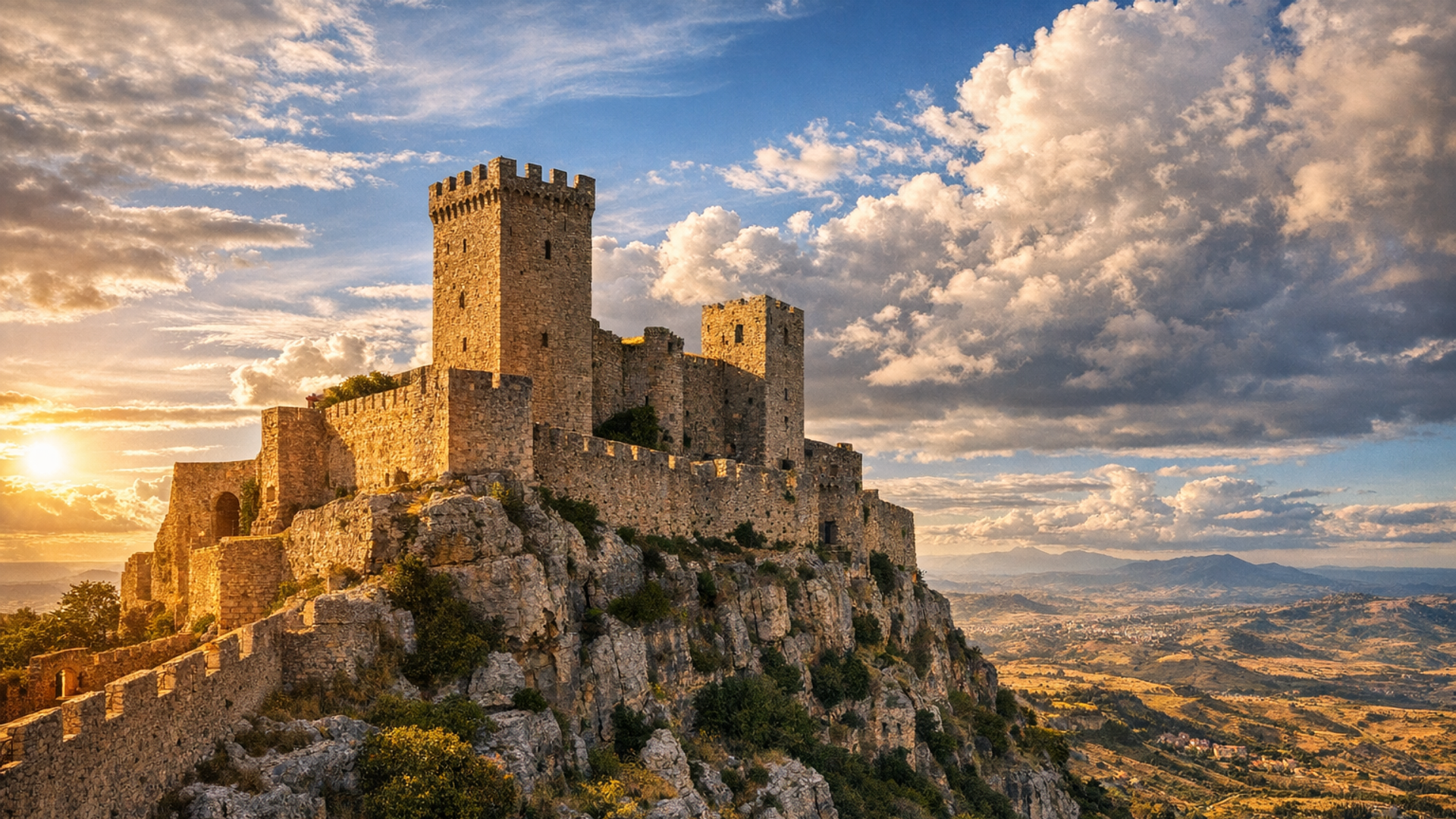
Dominating the highest point of the city, the is one of the largest and best-preserved medieval castles in all of Sicily. Built by the Normans and expanded by the Swabians and Aragonese, the castle covers more than 26,000 square metres and originally had as many as twenty towers, six of which still stand today. Walking within its walls means traversing centuries of history: Frederick II of Aragon chose it as his royal residence, and from here one enjoys one of the most extraordinary panoramas on the entire island. On clear days, the gaze stretches as far as Etna to the east and the Madonie mountains to the north, in a silence that feels eternal.
Castello di Lombardia
Torre di Federico II
In the heart of the city, isolated in a small public garden, stands the Torre di Federico II, one of Enna's most recognisable symbols. This octagonal tower, built in the 13th century at the behest of the Swabian emperor Frederick II, is a masterpiece of medieval geometry: its octagonal plan echoes that of Castel del Monte in Puglia, revealing the visionary mind of its patron. The tower was probably an astronomical observatory and a strategic lookout point. Today, climbing to the top, you can take in the entire surrounding valley at a glance.
Duomo di Enna
The Duomo di Enna, dedicated to the Madonna della Visitazione, is one of the most fascinating religious buildings in central Sicily. Founded in 1307 by Queen Eleanor of Anjou, it was almost completely rebuilt after a fire in the 16th century, taking on the baroque forms that still characterise it today. The interior is a triumph of grey marble columns, gilded stucco and artworks of great value. The Cathedral treasury holds the golden crown of the Madonna, a masterpiece of Sicilian goldsmithing that is carried in procession during Holy Week. The cathedral has been the spiritual heart of the city and the focal point of Enna's religious life for over seven centuries.
Rocca di Cerere
At the eastern edge of the city, on a rocky spur overlooking the valley, stands the Rocca di Cerere, a place charged with mythical and historical significance. Here, according to tradition, stood an ancient temple dedicated to Demeter — the Ceres of the Romans — goddess of fertility and grain. Enna was considered the centre of the Demeter cult in the ancient Mediterranean, and the bond with the goddess is still alive in the city's collective memory. Today only a few remains of the temple survive, but the place retains a sacred aura and the panorama that opens over the Sicilian countryside is of a moving beauty.
Must-See Surroundings
Lago di Pergusa
A few kilometres from Enna, nestled among gentle hills, Lago di Pergusa is the only natural lake in Sicily. But it is not only its geographical rarity that makes it special: this stretch of water is wrapped in one of antiquity's most powerful myths. According to Greek legend, it was on the shores of Pergusa that Hades abducted Persephone, the daughter of Demeter, dragging her down to the Underworld. The mother's grief caused the earth to wither, until Zeus decreed the girl's return for half the year — thus giving rise to the seasons. Walking around the lake, especially at dawn or dusk, when the light reflects on the water and the silence is almost absolute, is an experience that touches something deep. Today the lake is also a nature reserve and an important site for observing migratory birds.
Piazza Armerina and the Villa Romana del Casale
About 35 kilometres from Enna, the town of Piazza Armerina is home to one of the most extraordinary treasures of the Roman world: the Villa Romana del Casale, a UNESCO World Heritage Site since 1997. This luxurious 4th-century AD villa, probably belonging to a wealthy Roman aristocrat, preserves the largest and best-preserved floor mosaics of antiquity. Over 3,500 square metres of polychrome mosaics depict hunting scenes, games, deities and the famous scene of the "girls in bikinis" — athletes portrayed in surprisingly modern attire. A visit to the Villa del Casale is a journey into the heart of late-antique Roman life, absolutely unmissable for anyone in the province of Enna.
Calascibetta
Facing Enna, separated from it by a deep valley, lies Calascibetta, a medieval village of extraordinary beauty that seems to mirror the provincial capital. Its honey-coloured stone houses climb up the hillside, creating a panorama that is among the most photographed in inland Sicily. Founded by the Arabs and later developed by the Normans, Calascibetta preserves an intact historic centre, with narrow alleyways, ancient churches and a stillness that seems suspended in time. From Enna's belvedere, Calascibetta appears like a stone nativity scene; and from Calascibetta, Enna reveals itself in all its majesty. A relationship of mutual admiration between two villages that have gazed at each other for centuries.
Enna's Flavours: Local Cuisine
Enna's cuisine is that of the most authentic and rural Sicily, far from coastal influences and faithful to a centuries-old tradition. The flavours are intense, genuine, tied to the land and the season.
Stigghiole — lamb or kid intestines wrapped around spring onions and grilled over charcoal — are an ancient street food still found at local markets and festivals: a bold, rustic, unforgettable taste. Enna's arancine, filled with meat ragù or butter and ham, are among the most generous on the island, with a crispy coating and a soft, fragrant heart.
Local cheeses deserve a chapter of their own: aged Sicilian pecorino, caciocavallo ragusano and fresh provole can be found at small dairies in the province, where you can watch the artisan production process. Paired with a drizzle of local extra-virgin olive oil and homemade bread, they make a snack worth travelling for.
Among the pasta dishes, pasta al sugo di maiale — slow-cooked, fragrant with bay leaf and wild fennel — is the quintessential Sunday dish, the one that Enna's grandmothers still prepare today with the same care as always. In the restaurants of the historic centre you can also find excellent legume soups, pasta with broccoli and oven-baked lamb with potatoes: a cuisine modest in ingredients but extraordinarily rich in flavour.
Practical Tips
How to Get There
Enna is reachable by car via the A19 Palermo–Catania motorway, exiting at the Enna junction. The island's central location makes it easily accessible from both cities in about an hour and a half's drive. Those travelling by train can use Enna station, connected to the Palermo–Catania line, although rail connections are less frequent than road services. Buses from Palermo and Catania also run directly to the city centre.
When to Visit
The best times to visit Enna are spring (April–June) and autumn (September–October). In spring the surrounding countryside is a carpet of green and wildflowers, temperatures are mild and the light is perfect for photography. In autumn the colours turn warm and golden, the grape harvest enlivens the countryside and the cool air makes every walk a pleasure. Summer can be hot, but Enna's altitude keeps it noticeably cooler than the coastal cities.
Holy Week
If you are lucky enough to be in Enna during Holy Week, do not miss it for any reason. Enna's Easter processions are among the most evocative and ancient in Sicily, with a tradition dating back to the 16th century. Members of the various confraternities march in traditional dress, carrying on their shoulders the heavy "misteri" — wooden statues depicting scenes from the Passion of Christ — in an atmosphere of devotion and solemnity that takes your breath away. On Good Friday in particular, the procession winds through the streets of the historic centre amid torchlight, chanting and a silence heavy with emotion.
Parking and Getting Around the City
Enna is a compact city and the historic centre is largely pedestrianised or with restricted traffic. The best way to explore it is on foot, taking your time through the alleyways, viewpoints and squares. For those arriving by car, the main car parks are located on the outskirts of the centre, from which the heart of the city is easily reached on foot. A cable car connects the lower part of the city (Enna Bassa) with the historic centre in just a few minutes, also offering a lovely panoramic view during the ascent. Getting around without a car within the centre is not only possible, but recommended: Enna is best discovered slowly, at a walking pace, letting yourself be surprised at every turn.