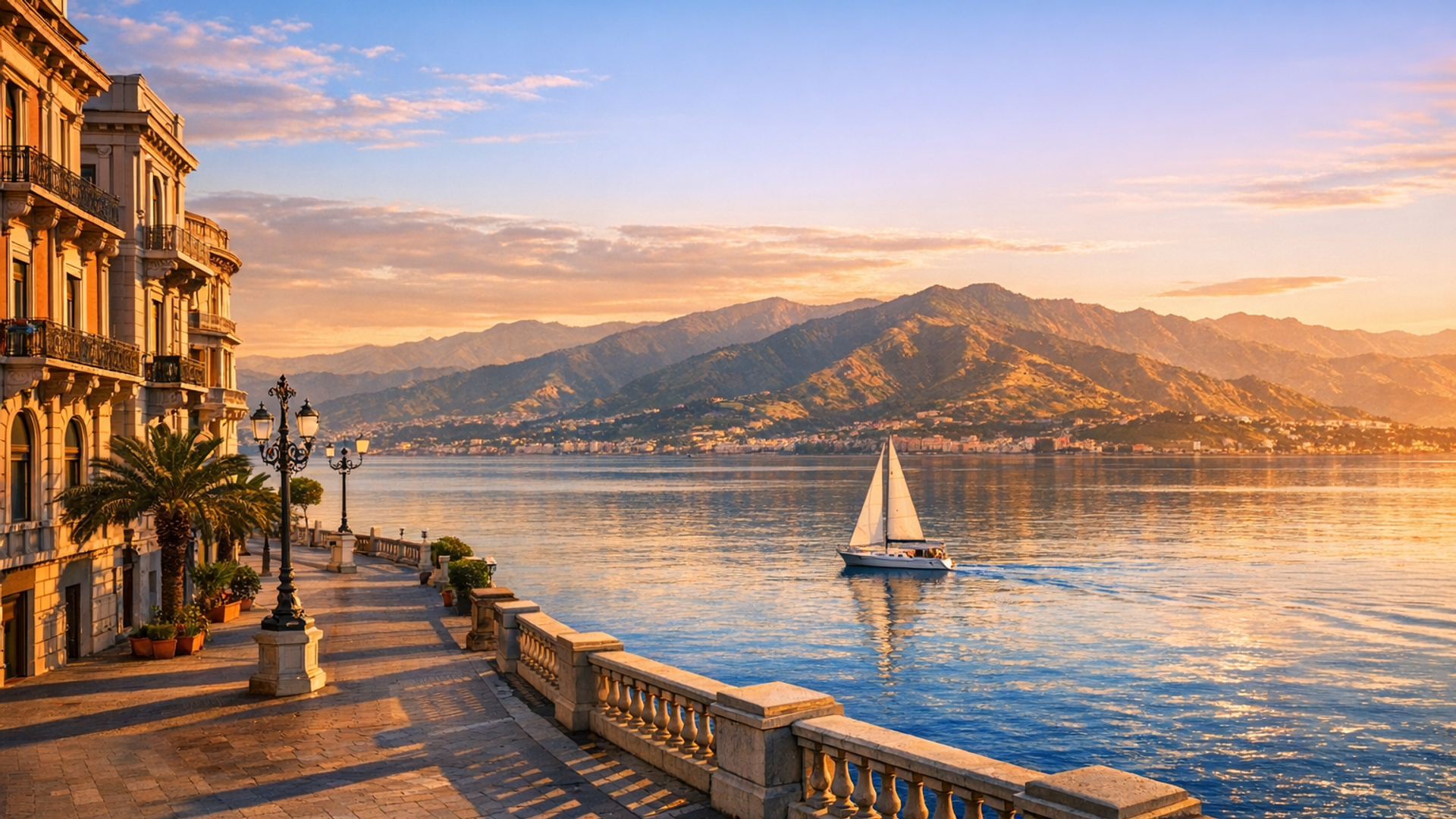
Messina Travel Guide: What to See, Eat & Do in Sicily
Guide to Messina: the Strait, Hidden Treasures, Authentic Flavours
October 21, 2026Il Team Seesily8 min read
Messina is far more than a simple transit port: overlooking the Strait that separates Sicily from Calabria, it holds a thousand-year history, extraordinary resilience, and an authentic soul waiting to be discovered. From the masterpieces of the Cathedral to the largest astronomical clock in the world, from the intense flavours of swordfish alla messinese to the lagoons of Ganzirri, this city surprises those who take the time to truly explore it. Let yourself be won over by Messina: the gateway to eastern Sicily that never ceases to amaze.
Introduction
Messina overlooks the Strait that bears its name like a silent sentinel, separated from Calabria by barely three kilometres of sea. It is the first city you encounter when arriving in Sicily by sea, yet it is often passed through quickly, considered little more than a transit point on the way to Taormina or Palermo. A mistake well worth avoiding.
The city carries in its DNA a history of destruction and rebirth. The catastrophic earthquake of 28 December 1908 — one of the most devastating ever recorded in Europe — almost completely razed Messina to the ground, claiming over 80,000 lives. Yet the city rose again, rebuilt itself, and returned to life with a tenacity that can still be felt walking its streets today. That resilience is an integral part of the Messinese character: proud, warm, and deeply rooted in its Sicilian identity.
Today Messina is a vibrant university city, rich in monuments, museums, and an authentic gastronomic scene that few truly know. This guide is designed for those who want to stop, look beyond the port, and discover everything this extraordinary city has to offer.
Main Attractions
The Cathedral and the Astronomical Clock
The beating heart of Messina is undoubtedly its Cathedral, the Duomo dedicated to Santa Maria Assunta. Founded in the Norman era in the 12th century and rebuilt after the 1908 earthquake, the Duomo preserves an imposing architecture that blends different styles, with a solemn and luminous interior. The mosaic floor, the side chapels, and the cathedral treasury all deserve a careful visit.
But it is outside, on the left flank of the cathedral, that one of the most fascinating mechanisms in Europe can be found: the astronomical clock of the bell tower, considered the largest astronomical clock in the world. Every day at noon, the clock comes to life in a mechanical spectacle of gilded figures moving across multiple levels, accompanied by melodies and the crowing of a golden rooster. An unmissable moment that draws visitors from all over the world.
Fontana di Orione
In front of the Cathedral stands the Fontana di Orione, a Renaissance masterpiece created by Giovanni Angelo Montorsoli in 1547. The fountain depicts Orion, the mythical founder of Messina, surrounded by allegorical figures representing the rivers Nile, Tiber, Ebro, and Camaro. It is one of the most beautiful sculptural works in Sicily and a natural meeting point for the people of Messina.
Museo Regionale di Messina
For art lovers, the Museo Regionale di Messina is a must-see. Housed in a modern building along Viale della Libertà, the museum holds an extraordinary collection that includes two absolute masterpieces by Caravaggio: the Resurrection of Lazarus and the Adoration of the Shepherds, both painted during the master's stay in Messina in 1608–1609. Also on display are works by Antonello da Messina, the great Sicilian painter of the 15th century who revolutionised Italian painting with his Flemish technique.
Forte Gonzaga and Views over the Strait
Perched on the hill overlooking the city, Forte Gonzaga is a 16th-century fortress built by the Spanish to defend Messina from Ottoman raids. Today it is open to visitors and offers one of the most spectacular panoramas in all of Sicily: the gaze sweeps across the Strait, the Calabrian coast, snow-capped Etna, and on clear days, all the way to the Aeolian Islands. A walk up to the fortress, through the hillside neighbourhoods, is already in itself a memorable experience.
Sacrario di Cristo Re
Located in the Montepiselli district, the Sacrario di Cristo Re is a place of reflection and remembrance dedicated to the victims of the 1908 earthquake. The church, with its large statue of Christ the Redeemer, offers another privileged panoramic viewpoint over the city and the Strait, and is a place of great spiritual significance for the people of Messina.
Surroundings and Day Trips
Capo Peloro and the Ganzirri Lagoons
Just a few kilometres from the city centre, heading north, you reach Capo Peloro, the northernmost tip of Sicily, where the Tyrrhenian Sea and the Ionian Sea meet. The landscape is evocative: the strip of land narrows between the waters, with Calabria very close on the horizon. Just before the cape lie the Ganzirri lagoons, two stretches of water separated from the sea by thin strips of land, famous for their mussel and clam farming. The restaurants overlooking the lagoons are the ideal spot to taste the freshest seafood in a relaxed and authentic atmosphere.
The Aeolian Islands
From the port of Messina, hydrofoils and ferries regularly depart for the Aeolian Islands, the volcanic UNESCO World Heritage archipelago north of Sicily. Lipari, Vulcano, Stromboli, Panarea: each has a unique character. In summer, departures are frequent and allow for comfortable day trips or longer stays. Messina is the ideal starting point for exploring this wild and fascinating corner of the Mediterranean.
Taormina and Castelmola
About 50 kilometres south of Messina, Taormina is one of Sicily's most celebrated destinations, with its Greco-Roman theatre overlooking Etna and the sea. Reachable in less than an hour by car or train, it is perfect for a half-day trip. Just above Taormina, the village of Castelmola offers even more vertiginous panoramas and the chance to taste the famous local almond wine.
The Peloritani Mountains
The Monti Peloritani massif extends behind Messina, offering landscapes of great natural beauty with oak forests, hiking trails, and small, almost forgotten medieval villages. For those who love trekking and nature, the Peloritani are a surprising discovery, far from the mass tourist circuits.
Cuisine and Local Specialities
Messina boasts a rich and proud gastronomic tradition, deeply tied to the sea and local produce. Eating well in Messina is not difficult: you just need to know what to look for.
Swordfish alla Messinese
The Strait of Messina has for centuries been one of the richest swordfish fishing grounds in the Mediterranean. Traditional fishing with the feluca — the characteristic boat with a long bowsprit — is still practised, and swordfish is the undisputed star of local cuisine. Pesce spada alla messinese is prepared with tomato, olives, capers, pine nuts, and raisins, in a sweet-and-sour balance of flavours that is typically Sicilian. Not to be missed.
Focaccia Messinese
Focaccia messinese is a local institution: thick, soft, topped with tuma (a fresh local cheese), anchovies, tomato, and escarole. It is unlike any other Italian focaccia and represents one of the most beloved street foods among the people of Messina. Found in bakeries and rosticcerie throughout the city, it is often eaten standing up, wrapped in a sheet of paper.
Pitoni
Pitoni (or pidoni) are another must of Messinese street food: triangles of fried dough filled with escarole, tuma, and anchovies. Crispy on the outside and stringy on the inside, they are eaten hot straight from the oven. Together with focaccia, they are the symbol of street food in Messina.
Granita with Brioche
As throughout Sicily, granita is a daily ritual, but in Messina — and across eastern Sicily — it reaches particularly exceptional levels. Granita with coffee, lemon, almond, or mixed berries, accompanied by a still-warm brioche col tuppo, is the perfect breakfast to start the day. Don't skip it even if you're just passing through.
Strait Anchovies
The anchovies fished in the Strait of Messina are renowned for their exceptional quality. Marinated, fried, or simply dressed with oil, lemon, and parsley, they make a simple yet extraordinary starter. At the fish markets — such as the one in Piazza Cairoli — you can buy them fresh directly from the fishermen.
Practical Tips
How to Get There
The most evocative way to arrive in Messina is undoubtedly by ferry from Villa San Giovanni, in Calabria. The crossing takes about 20 minutes and offers a spectacular view of the Strait and the city's skyline. Ferries depart very frequently, practically every hour, and carry both pedestrians and vehicles. There are also ferry connections from Reggio Calabria, with slightly longer journey times but equally scenic views. Those arriving by train don't even need to get off: trains are loaded directly onto the ferries and cross the Strait without interruption.
Getting Around the City
Messina has a modern tram line connecting the main areas of the city, from the port to the historic centre and out to the peripheral neighbourhoods. It is convenient, affordable, and an excellent way to get your bearings. The historic centre is largely walkable: the main attractions are concentrated in a relatively compact area around the Cathedral and the waterfront. To reach the hills and the surrounding area, it is advisable to rent a car or use taxis.
When to Visit
The best time to visit Messina is spring (April–June) and early autumn (September–October). Temperatures are pleasant, the sea is already warm in September, and the city is less crowded than in the summer months. Summer is hot and humid, but lively thanks to cultural events and evenings along the waterfront.
The Vara: a UNESCO Tradition
If you are lucky enough to be in Messina on 15 August, do not miss the procession of the Vara, one of the oldest and most spectacular religious traditions in all of Sicily. The Vara is a gigantic processional structure over 15 metres tall, decorated with angelic figures and pulled by hand by hundreds of the faithful through the streets of the city centre. The procession, which celebrates the Assumption of the Virgin Mary, has been recognised by UNESCO as an intangible cultural heritage of humanity. An experience of faith, folklore, and community that leaves an indelible impression.
Plan Your Trip to Messina
Let AI create a personalized itinerary for Messina