Guide to Ragusa Ibla: Sicilian Baroque & Val di Noto
Guide to Ragusa: Discovering Ragusa Ibla and Sicilian Baroque
October 11, 2026Il Team Seesily15 min read
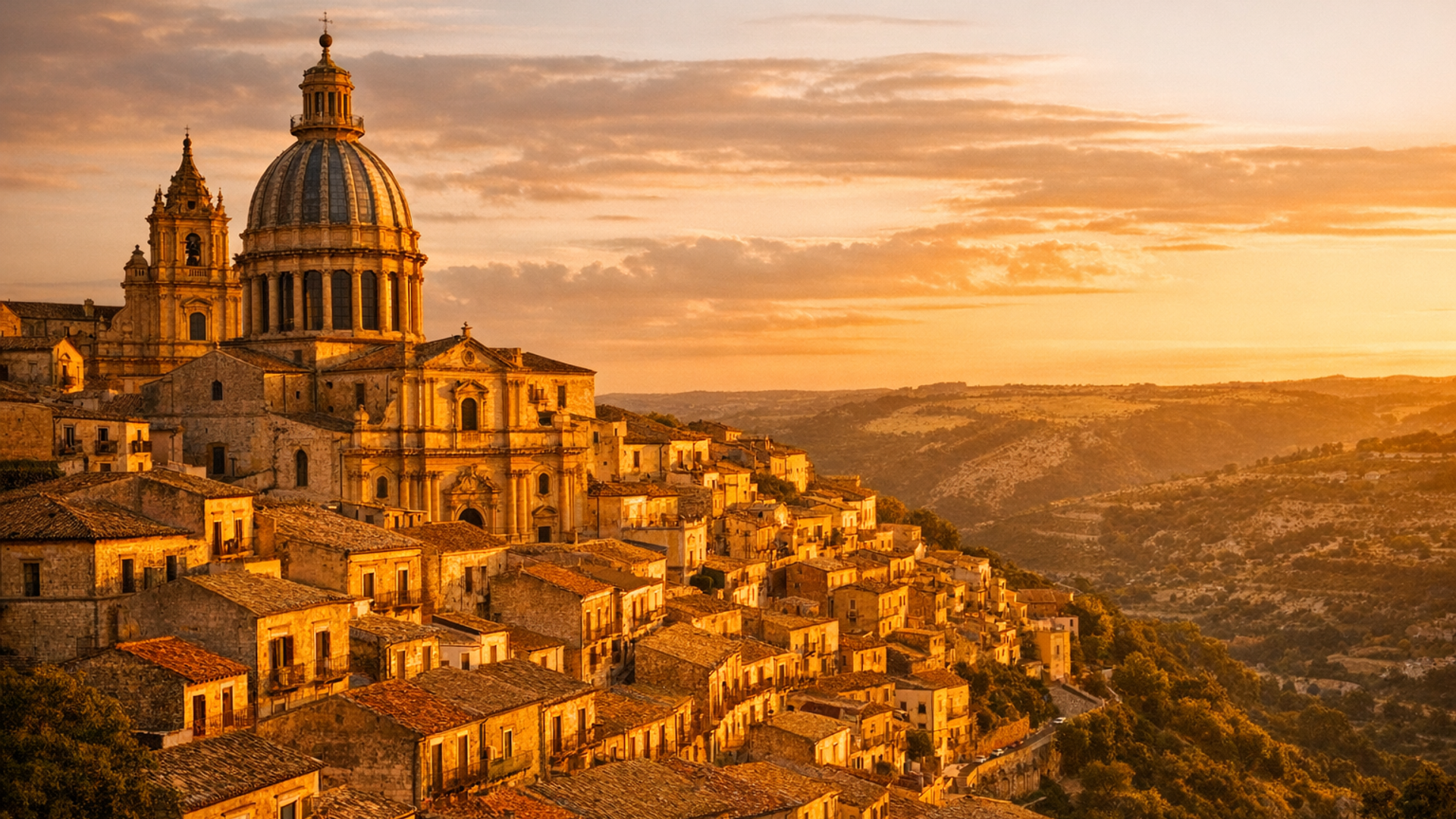
Ragusa is a double city, suspended between sky and stone: on one side the lively Ragusa Superiore, on the other the magnificent Ragusa Ibla, a baroque jewel nestled among the Iblean valleys. Strolling through its golden alleyways, admiring the Cathedral of San Giorgio rising above Piazza del Duomo, and losing yourself among noble palaces and silent gardens is an experience that stays with you forever. This guide takes you on a journey to discover every corner of one of Sicily's most beautiful and surprising cities.
Introduction
There is a moment, arriving in Ragusa, when you stop without meaning to. Perhaps it is the afternoon light setting the honey-coloured limestone ablaze, perhaps it is the unexpected silence rising from the valley, or perhaps it is simply the feeling of having entered a place that time has treated with rare care. Ragusa is a city that does not reveal itself quickly, and perhaps that is its greatest charm.
Situated in the heart of the Iblean Mountains, in the south-eastern corner of Sicily, Ragusa is in fact two cities in one. Ragusa Superiore, the modern part built after the devastating earthquake of 1693, spreads across a plateau with its tree-lined avenues, lively squares and nineteenth-century palaces. Ragusa Ibla, on the other hand, is something entirely different: an ancient village clinging to a rocky spur, also rebuilt after the earthquake but according to the most lavish and theatrical canons of Sicilian baroque, so much so that it has been recognised as a UNESCO World Heritage Site along with the other towns of the Val di Noto.
Between the two souls of the city flows a history of rivalry and coexistence, of bell towers gazing at each other from afar and staircases connecting them like veins of stone. Coming to Ragusa means accepting this duality, letting yourself be carried from one level to the other, and discovering that every corner hides a surprise.
Ragusa Ibla: The Baroque Heart
Descending towards Ragusa Ibla is an almost ritual act. You can take the staircase of Santa Maria delle Scale, which connects the two levels of the city with a series of irregular steps and breathtaking views, or arrive by car along the road that winds through the olive groves. Either way, the arrival has something solemn about it.
Piazza del Duomo and Its Grandeur
The beating heart of Ragusa Ibla is Piazza del Duomo, one of the most beautiful squares in Italy. Long, airy, flanked by noble palaces and baroque churches, the square has a scenic quality that takes your breath away. At sunset, when the raking light enhances every cornice and every wrought-iron balcony, it feels like being on the set of a period film.
The square is not merely a place of passage: it is Ibla's drawing room, the spot where the people of Ragusa gather in the evening for their stroll, where children play among the fountains and tourists sit at café tables sipping coffee while watching the world go slowly by. There is a different quality of time here, as if the clock hands turn more slowly.
The Cathedral of San Giorgio
Dominating the square with its convex façade and the blue dome soaring into the sky, the Cathedral of San Giorgio is the absolute symbol of Ragusa Ibla and one of the masterpieces of Sicilian baroque. Designed by architect Rosario Gagliardi and completed in 1775, the church is a triumph of columns, volutes, statues and decorations layered in a vertical crescendo of extraordinary elegance.
The interior is equally rich: luminous naves, polychrome marble altars, stained-glass windows that filter the light into a thousand colours. Take the time to sit in silence and let the atmosphere envelop you. The Cathedral of San Giorgio is part of the UNESCO site "Late Baroque Towns of the Val di Noto", a recognition that certifies its universal value.
The Iblean Garden
At the eastern end of Ragusa Ibla, the Giardino Ibleo is an oasis of peace and beauty. This nineteenth-century public park, overlooking the Iblean valley, is the ideal place for a restorative break after hours of walking among churches and alleyways. Palm trees, bougainvillea, benches in the shade of centuries-old trees: the garden has the slow and gentle rhythm of places that are in no hurry.
From the garden's belvedere opens one of the most evocative panoramas in all of Sicily: the deep valley, the stone ravines, the olive groves stretching to the horizon and, in the distance, the outline of the Ragusa countryside. Within the park you will also find three deconsecrated churches — San Giacomo, San Domenico and the Cappuccini — which add a touch of romantic melancholy to the whole.
The Baroque Alleyways
The true soul of Ragusa Ibla is discovered by leaving the main streets and slipping into the alleyways. Here the baroque becomes domestic, everyday: carved portals on modest houses, balconies with brackets shaped like grotesque figures, staircases that rise and fall without any apparent logic. Every bend reveals something unexpected — a small church with its door ajar, a flower-filled courtyard, a cat sleeping on a stone warmed by the sun.
Among the churches not to be missed are the Church of Santa Maria dell'Itria, with its bell tower clad in coloured majolica tiles, and the Church of San Giuseppe, with its elliptical façade that anticipates almost modern architectural solutions. The noble palaces — Palazzo Cosentini, Palazzo La Rocca — display the most elaborate balconies in the city, with brackets carved into fantastic forms: knights, mermaids, mythological figures.
The Viewpoints
Ragusa Ibla is a city of panoramas. Beyond the Giardino Ibleo, several points in the city offer extraordinary views over the valley and the baroque rooftops. The belvedere of Piazza Pola, reachable on foot from the centre of Ibla, offers an unusual perspective on the bell towers and domes of the lower city. The staircase of Santa Maria delle Scale, halfway between the two levels, provides unforgettable glimpses both towards Ibla and towards Ragusa Superiore.
For photographers and sunset lovers, the advice is to position yourself at one of these panoramic points during the golden hour, when the warm late-afternoon light transforms the limestone into pure gold.
Tips for Visiting
Ragusa Ibla is best visited in the early morning hours or late afternoon, when the light is most beautiful and the crowds thin out. In summer, the middle hours of the day can be very hot: it is better to take refuge in one of the churches or a shaded café. Guided tours are available at the local tourist office and allow you to discover details and stories that are hard to find in traditional guidebooks. Many alleyways are not signposted: getting lost is part of the experience, and there is nothing to worry about — Ibla is small and you can always find your way back.
Ragusa Superiore: The Modern City
While Ibla captures the imagination with its timeless baroque, Ragusa Superiore has its own quiet dignity and an authentic everyday life worth exploring. Built after 1693 on a more stable plateau, the upper city is the administrative and commercial centre of Ragusa, with an urban vitality that pleasantly contrasts with the tranquillity of Ibla.
The Cathedral of San Giovanni Battista
The most important monument in Ragusa Superiore is the Cathedral of San Giovanni Battista, which dominates Piazza San Giovanni with its three-tiered baroque façade. Less celebrated than the Cathedral of San Giorgio, the cathedral nonetheless has its own sober grandeur and an interior rich in works of art, including seventeenth-century canvases and a monumental organ. The square in front is one of the favourite gathering places for the people of Ragusa, enlivened by bars and pastry shops where you can sample local specialities.
The Iblean Archaeological Museum
For those who want to understand the deep history of this territory, the Museo Archeologico Ibleo is an unmissable stop. The museum houses finds covering an extraordinary span of time, from prehistory to the medieval period, with particular attention to the civilisations that succeeded one another in the Iblean Mountains: Sicels, Greeks, Romans, Arabs, Normans. The collections of ceramics, coins, sculptures and everyday objects paint a vivid and articulate portrait of a land that has always been a crossroads of cultures.
The Historic Districts and the Ponte dei Cappuccini
Ragusa Superiore preserves several historic districts of great interest, with churches, convents and palaces that tell the story of the post-earthquake city. The Ponte dei Cappuccini is the physical and symbolic link between the two levels of the city: a stone bridge that spans the valley with austere elegance, offering spectacular views both over Ibla and over the surrounding countryside. Walking across the bridge at dusk, as the lights of Ibla come on one by one in the valley below, is one of those moments you carry with you forever.
Day Trips: The Baroque Val di Noto
Ragusa is the ideal starting point for exploring one of Italy's most extraordinary territories: the Val di Noto, the region of Sicilian baroque recognised by UNESCO. Within a radius of just a few kilometres lie some of Sicily's most beautiful cities, each with its own personality and treasures.
Modica and Chocolate
Just 15 kilometres from Ragusa, Modica is perhaps the most famous city in the Val di Noto after Siracusa. Built across two converging valleys, with its baroque churches seemingly emerging from the living rock, Modica has a dramatic and almost theatrical beauty. But what makes it unique in the world is its chocolate: Modica chocolate is produced according to an Aztec recipe passed down by the Spanish, without the addition of fats or milk, using a cold-processing method that preserves the granularity of the sugar and creates a unique, crumbly and intense texture.
The chocolate shops line the Corso Umberto I, Modica's main street: Antica Dolceria Bonajuto (the oldest in Italy, founded in 1880), Sabadì, Quetzal and many others offer tastings and bars in dozens of flavours, from the classic cinnamon and vanilla to more creative variations with chilli, sea salt or citrus. Buy more than you think you can eat: you will regret it otherwise.
Scicli
Scicli is the least known of the Val di Noto cities, and perhaps for that very reason the most authentic. Nestled in a valley between three hills, with its baroque churches reflected in silent streets, Scicli has a suspended and melancholy atmosphere that captivates the most sensitive visitors. Palazzo Beneventano, with its façade decorated with grotesque masks and fantastic figures, is one of the most original examples of Sicilian baroque. The Church of San Matteo, perched on one of the hills, offers a panoramic view over the city that is worth the climb. Fans of Inspector Montalbano will recognise Scicli as the location of the Town Hall of Vigàta in the television series.
Noto
Noto is the queen of Sicilian baroque, the golden city par excellence. Rebuilt from scratch after the 1693 earthquake on a different site from the original, Noto is a masterpiece of baroque urban planning: the streets are wide and straight, the palaces follow one another in a sequence of gilded façades that seem lit from within. Corso Vittorio Emanuele, the main street, is one of the finest avenues in Italy, flanked by churches, palaces and staircases that open like theatrical wings.
The Cathedral of Noto, with its three-tiered façade and the dome that dominates the city, is the symbol of this baroque triumph. Do not miss Palazzo Nicolaci di Villadorata, with its balconies decorated with mythological figures among the most elaborate in Sicily. In May, during the Infiorata di Noto, the Corso is transformed into a carpet of flowers: a spectacle that draws visitors from all over the world.
The UNESCO Circuit of the Val di Noto
Ragusa, Modica, Scicli, Noto, Caltagirone, Militello Val di Catania, Catania and Palazzolo Acreide: these eight towns form the UNESCO site "Late Baroque Towns of the Val di Noto", recognised in 2002 as a World Heritage Site. The recognition celebrates the extraordinary artistic and architectural flowering that followed the earthquake of 1693, when the destroyed cities were rebuilt according to the principles of late baroque in a collective undertaking without precedent in the history of architecture. Visiting the complete circuit requires at least three or four days, but even a single day dedicated to two or three cities leaves an indelible impression.
Ragusa Flavours: What to Eat
Ragusa's cuisine is one of the richest and most distinctive in Sicily, rooted in a peasant and pastoral tradition that values simple ingredients and authentic flavours. Coming to Ragusa without dedicating time and attention to the food would be an unforgivable mistake.
Modica Chocolate
We have already spoken of Modica chocolate, but it is worth reiterating: it is a gastronomic experience unique in the world. Its grainy texture, its bitter intensity, its ability to melt slowly in the mouth releasing complex aromas make it something completely different from any other chocolate. Taste it pure, without pairings, at least the first time.
Scacce Ragusane
Scacce are the most typical gastronomic speciality of the Ragusa area: a kind of stuffed flatbread, made with an extremely thin sheet of bread dough that is filled, folded over itself several times and then baked in the oven. The traditional fillings are tomato with onion, tomato with cheese, and ricotta with sausage. Scacce can be found in bakeries and delicatessens throughout the province and are the street food par excellence: inexpensive, filling and delicious.
Caciocavallo Ragusano DOP
Caciocavallo Ragusano DOP is one of Sicily's finest cheeses, produced with whole milk from the Modicana cow according to traditional methods handed down over centuries. It has a characteristic rectangular shape, a compact paste and a flavour that ranges from sweet and buttery in young cheeses to sharp and intense in aged ones. It can be found at local markets, in food shops and directly from producers in the Ragusa countryside. Paired with a drizzle of orange-blossom honey or a fig-cactus jam, it makes a starter of rare elegance.
Pane Cunzato
Pane cunzato — literally "seasoned bread" — is one of those simple foods that achieve perfection. A homemade loaf, opened in half and dressed with extra-virgin olive oil, fresh tomato, oregano, salt and sometimes anchovies or olives: a sandwich that tastes of summer, of the countryside, of authentic Sicily. You will find it in the most traditional trattorias and at markets, and it costs very little.
Sicilian Granita
Sicilian granita is not a simple ice cream: it is a philosophy. In Ragusa and the surrounding area, granita is eaten for breakfast, accompanied by a brioche col tuppo — the sweet roll with the characteristic topknot of eastern Sicily. The most traditional flavours are almond, lemon, coffee and blackberry, but artisan gelaterie offer dozens of seasonal variations. Starting the day with a coffee granita and a warm brioche is one of the simplest and most irresistible pleasures that Sicily can offer.
Where to Eat and Local Markets
For an authentic lunch in Ragusa Ibla, look for the trattorias hidden in the alleyways, away from the main tourist routes: often the best ones do not even have a website. The weekly market in Ragusa is the right place to buy cheeses, cured meats, vegetables and local products directly from producers. Do not miss the arancine (in Ragusa they are called this, in the feminine form), the seasoned olives and the almond sweets that pastry shops display in their windows like jewels.
Practical Information
How to Get There
Ragusa is not the easiest destination to reach, and perhaps that is also why it has remained so authentic. The nearest airport is Catania Fontanarossa, about 100 kilometres away, from which Ragusa can be reached in about an hour and a half by car. Comiso Airport, just 15 kilometres from Ragusa, is served by some low-cost airlines with seasonal flights from several Italian and European cities: it is worth checking availability.
By car, Ragusa is reached via state roads that cross the hilly Iblean landscape: the drive is pleasant but requires attention, as the roads are often narrow and winding. By train, Ragusa station is connected to Siracusa and Catania with a regional service, but journey times are long and frequencies limited. To explore the territory freely, a car is practically indispensable.
When to Go
Spring (April and May) and autumn (September and October) are the ideal seasons to visit Ragusa. Temperatures are mild, the light is extraordinary, tourists are fewer and the countryside is at its best: in spring blooming with almond trees and poppies, in autumn golden with olive trees and vineyards. Summer is hot and crowded, but has its own charm in the lively evenings and patron saint festivals. Winter is quiet and often sunny, perfect for those seeking authenticity without crowds.
Parking
Parking in Ragusa requires a little strategy. In Ragusa Superiore, the most convenient car parks are in Piazza del Popolo and in the streets adjacent to the historic centre. In Ragusa Ibla, the main car park is located at the entrance to the village, near the Church of Santa Maria delle Scale: from there you walk down towards the centre. Alternatively, some private car parks offer reasonable rates. Avoid venturing into the narrowest alleyways of Ibla by car: the streets are often one-way and the risk of getting stuck is real.
Inspector Montalbano
For millions of Italians and fans around the world, Ragusa and its surroundings are inextricably linked to Inspector Montalbano, the character created by Andrea Camilleri and brought to television by Luca Zingaretti. The series, set in the fictional Vigàta, was filmed largely in this part of Sicily, and many locations are immediately recognisable to fans.
Ragusa Ibla is the television Vigàta par excellence: Piazza del Duomo, the baroque alleyways, the staircase of Santa Maria delle Scale are all recurring settings in the series. Scicli is home to the Town Hall of Vigàta (the Palazzo Municipale di Scicli). Punta Secca, a small seaside hamlet in the municipality of Santa Croce Camerina, is Montalbano's house by the sea — today transformed into a holiday home that can be rented. Donnalucata, Marina di Ragusa, Sampieri: every corner of this coastline has its Montalbano story.
For fans, there are dedicated tours that visit the main sets of the series: an original and enjoyable way to discover the territory through the eyes of the most beloved inspector in Italian television.