Trapani Travel Guide: Salt Pans, Egadi Islands & More
Guide to Trapani: what to see, where to eat and how to get around
October 1, 2026Il Team Seesily11 min read
Trapani is one of the most authentic gems of western Sicily: a sickle-shaped promontory overlooking the Mediterranean, surrounded by pink salt flats, a baroque historic centre and the crystal-clear waters of the Egadi Islands. In this guide you'll discover the must-see sights, the extraordinary cuisine — from fish couscous to Trapanese pesto — and all the practical tips you need to make the most of the city. Let yourself be won over by Trapani: a destination that blends millennia of history, unspoilt nature and unforgettable flavours.
Trapani is a city that surprises. Perched on a slender sickle-shaped promontory jutting into the Mediterranean, this city in western Sicily holds centuries of history, a cuisine of extraordinary richness and breathtaking landscapes. The pink salt flats at sunset, the silent windmills, the baroque domes of the historic centre and the horizon dotted with the Egadi Islands: Trapani is all this and much more. It is not a mass-tourism destination, and for that very reason it retains a rare authenticity, capable of captivating visitors with the same intensity with which the westerly wind caresses its shores.
The city bears the traces of every civilisation that has inhabited it: Phoenicians, Greeks, Romans, Arabs, Normans and Spaniards have all left indelible marks on its architecture, language and above all its cuisine. The tradition of the mattanza — the ancient bluefin tuna fishing practised for centuries in the waters of the Egadi archipelago — has today almost disappeared, but it lives on in collective memory and in local museums. Visiting Trapani means immersing yourself in an authentic Sicily, far from the most well-trodden tourist circuits, where time seems to flow at a different pace.
What to see in Trapani
The Trapani and Paceco Salt Flats
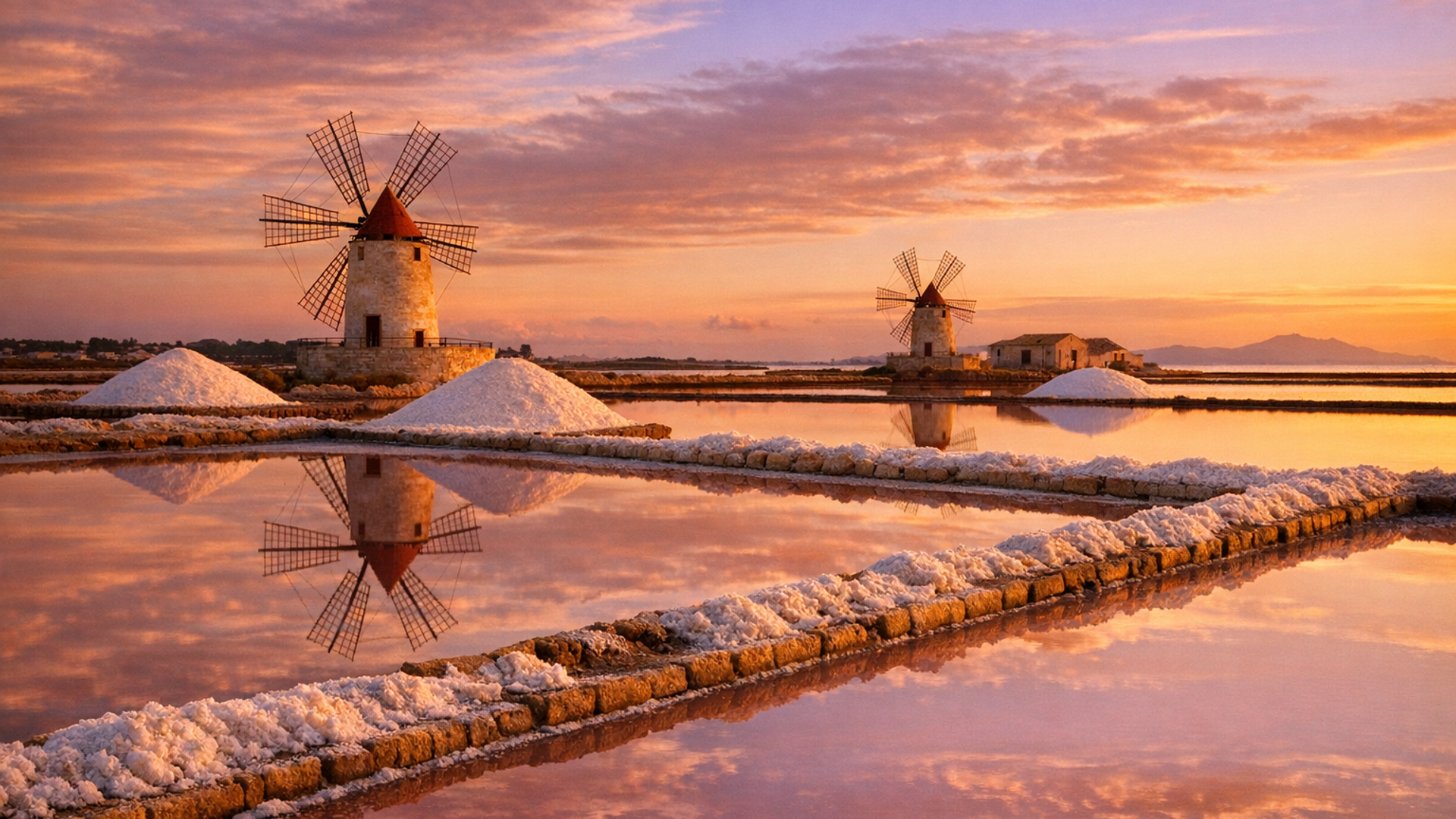
The salt flat landscape is perhaps the most iconic image of Trapani: an expanse of water basins that at sunset turn shades of pink, orange and violet, dotted with the elegant silhouettes of windmills. The Trapani and Paceco Salt Flats Nature Reserve is a protected area of great natural value, where it is possible to observe pink flamingos, herons and numerous other migratory bird species. The sea salt produced here is considered among the finest in Italy, rich in magnesium and low in sodium thanks to the natural evaporation favoured by sun and wind. The Salt Museum, housed in an ancient windmill along the road to Marsala, tells the thousand-year history of this production with original tools and explanatory panels. A walk along the path that skirts the basins, especially at sunset, is an experience that stays with you.
The Historic Centre
The heart of Trapani is a labyrinth of alleyways, squares and baroque churches that winds along the promontory to the city's outermost tip. Corso Vittorio Emanuele is the main axis of city life: an elegant promenade flanked by noble palaces, historic cafés and artisan shops. The Cathedral of San Lorenzo, with its baroque façade and richly decorated interior, is one of the city's most important monuments and houses works of art of great value. In the alleyways of the centre you can still breathe the atmosphere of medieval Trapani, with its arches, hidden courtyards and churches that open up unexpectedly between the houses. The Fish Market Square, in the morning, is a place of authentic life where fishermen sell the catch of the night spent at sea.
The Ligny Tower
Built in 1671 at the behest of the Spanish viceroy Claude Lamoral, Prince of Ligne, the Ligny Tower stands at the westernmost point of the Trapani promontory and offers a breathtaking panoramic view over the open sea and the Egadi Islands. The tower today houses the Museum of Prehistory, which collects archaeological finds from the Trapani area, with particular attention to prehistoric and Phoenician civilisations. Walking to the tower at sunset, when the sun descends towards the horizon turning the sea red and gold, is one of the most evocative moments Trapani can offer. The isolated, windswept position of the tower is a reminder of how this city has always been an outpost on the Mediterranean, a place of encounter and exchange between different cultures.
The Colombaia Castle
A short distance from the shore, connected to the mainland by a slender isthmus, stands the Colombaia Castle: a medieval fortress that dominates the entrance to Trapani's harbour with its imposing bulk. Probably built in the Norman era and expanded by the Aragonese, the castle has served over the centuries as a military fortification, a watchtower and even a prison. Today it can be seen from the outside and from the harbour promenade, and its silhouette is reflected in the harbour waters in the early morning hours, creating one of the city's most photographed panoramas. The castle is closely linked to the history of the Battle of the Egadi Islands in 241 BC, when the Roman fleet defeated the Carthaginian fleet in these very waters, bringing the First Punic War to an end.
The Church of Purgatory and the Misteri
The Church of Purgatory, in the heart of the historic centre, houses one of Trapani's most precious and moving treasures: the twenty wooden sculptural groups from the 17th and 18th centuries depicting scenes from the Passion of Christ, known as the Misteri. Every year, during Holy Week, these masterpieces of Sicilian baroque art are carried in procession through the city streets in a ceremony that lasts almost twenty-four hours, accompanied by solemn music and the deeply moved participation of the entire community. The Misteri procession is considered one of the most beautiful and touching in Italy, capable of attracting visitors from all over the world. Even outside the Easter period, visiting the church to admire these sculptures up close is an experience of great emotional and artistic intensity.
Day trips
Erice: the medieval hilltop village
Just ten kilometres from Trapani, but at almost 750 metres above sea level, Erice is a medieval village suspended among the clouds that seems to have stepped out of a fairy tale. The most evocative way to reach it is by cable car from the Casa Santa district: in just a few minutes you rise through pine forests and arrive in a completely different world, with its lava-stone lanes, cyclopean walls and panoramas that on clear days stretch as far as Tunisia. The Castle of Venus, built by the Normans on the remains of an ancient temple dedicated to the goddess, dominates the village from above and offers an extraordinary view over the salt flats and the Egadi Islands. Erice is famous throughout Sicily for its sweets: the Pasticceria di Maria Grammatico is a must-stop, with its marzipans, cream-filled genovesi and almond pastries following recipes handed down by cloistered nuns. Strolling through the streets of Erice early in the morning, when the mist still wraps the alleyways and the tourists have not yet arrived, is an almost mystical experience.
Favignana and the Egadi Islands
Less than an hour by ferry or hydrofoil from Trapani's port, the Egadi Islands — Favignana, Levanzo and Marettimo — boast some of the clearest waters in the Mediterranean. Favignana, the largest and most accessible, is famous for its yellow tuff quarries that have created lunar landscapes of great beauty, and for its turquoise coves where swimming and snorkelling are unforgettable experiences. The Tuna Museum, housed in the former Florio factory, tells the story of the mattanza and the canning industry that made Favignana famous throughout the world. Levanzo, the smallest of the three islands, houses the Genovese Cave with its cave paintings dating back to the Palaeolithic. Marettimo, the wildest and most remote, is a paradise for trekking and scuba diving enthusiasts, with seabeds rich in marine life and historic wrecks. A day in the Egadi Islands is enough to understand why they are considered among the most beautiful in Italy.
Marsala and the wine region
Just thirty kilometres south of Trapani, Marsala is a city rich in history and wine. Its Phoenician origins are attested by the Island of Mozia, reachable by boat from the seafront, where one of Sicily's most important archaeological sites stands, home to the celebrated Giovinetto di Mozia, a Greek sculpture of extraordinary beauty. Marsala's historic centre, with its historic wine cellars and noble palaces, is pleasant to explore on foot. The Florio and Pellegrino wineries offer guided tours that tell the story of Marsala wine, the celebrated fortified wine that takes its name from the city and was made famous throughout the world by the English admiral John Woodhouse in the 18th century. The wine region around Marsala also produces excellent dry white wines — Grillo, Catarratto, Zibibbo — perfect to pair with fresh fish from the coast.
What to eat and drink
Fish couscous
Trapani's signature dish is undoubtedly fish couscous, a living testament to centuries of Arab influence on western Sicilian cuisine. Unlike North African couscous, the Trapanese version is dressed with a rich and fragrant fish broth, prepared with scorpionfish, gurnard, grouper and other reef fish, flavoured with onion, garlic, tomato, almonds and spices. Every family has its own secret recipe, handed down from generation to generation, and every year in San Vito Lo Capo — a few kilometres from Trapani — the Cous Cous Fest is held, an international event dedicated to this dish that draws chefs and visitors from all over the world. Tasting a good fish couscous in a trattoria in Trapani's historic centre is a gastronomic experience that alone is worth the trip.
Trapanese pesto and busiate
Busiate are Trapani's typical pasta: a long format rolled into a spiral, traditionally made by wrapping the dough around a knitting needle or a reed. The quintessential dressing for busiate is Trapanese pesto, a raw sauce made from toasted almonds, fresh tomatoes, basil, garlic, extra-virgin olive oil and a grating of salted ricotta. Unlike Genoese pesto, the Trapanese version contains neither pine nuts nor aged cheese, and the result is a fresher, more fragrant and slightly rustic sauce. This simple yet extraordinary dish perfectly encapsulates Trapanese cuisine: humble ingredients, essential technique, memorable flavour.
Bluefin tuna
Mediterranean bluefin tuna has been at the centre of Trapani and the Egadi Islands' gastronomic culture for centuries. Although the mattanza — the traditional collective tuna fishing — has today almost disappeared, tuna remains the star of local cuisine in a thousand different preparations: raw as carpaccio with oil and lemon, pan-seared with capers and olives, preserved in artisanal olive oil, or transformed into bottarga — the dried and pressed roe that is grated over pasta like a truffle of the sea. Favignana tuna bottarga is considered among the finest in the world and is sold in markets and delicatessens throughout the area.
Wines and sweets
Marsala wine is the area's most famous wine product, but western Sicily also produces excellent dry white wines — Grillo, Catarratto, Zibibbo — perfect to pair with fish. For lovers of sweet wines, the Passito di Pantelleria, produced on the eponymous island reachable from Trapani, is one of Italy's great dessert wines. The Trapanese breakfast almost invariably includes a granita with brioche: almond granita, made with Avola almonds, is the most beloved local version, but the coffee and lemon varieties are equally unmissable. The almond pastries of Erice, cassata and cannoli complete a gastronomic panorama of extraordinary richness.
Practical tips
How to get there
Trapani can be reached by air via two airports: the Vincenzo Florio airport at Trapani Birgi, just fifteen kilometres from the city and serving mainly domestic and seasonal low-cost flights, and the Falcone-Borsellino airport in Palermo, about an hour and a half away, with broader international connections. By train, Trapani is linked to Palermo by a regional service that passes through beautiful landscapes, although journey times are long (around two and a half hours). Buses run by Segesta and Flixbus connect Trapani with Palermo, Agrigento and other Sicilian cities efficiently and affordably. Trapani's port is an important hub for ferries to the Egadi Islands, Pantelleria, Sardinia and Tunisia, with frequent departures during the summer season.
How to get around
Trapani's historic centre is compact and perfectly walkable: from the railway station to the Ligny Tower is less than a twenty-minute walk. To reach the salt flats and windmills, located about five kilometres from the centre, it is convenient to hire a bicycle — several shops in the centre offer this service at reasonable prices — or to take the urban bus. Ferries and hydrofoils to the Egadi Islands depart from the central port and run frequently during summer; it is advisable to book in advance in July and August. For Erice, the cable car departs from the Casa Santa district, reachable by bus from the centre; alternatively, you can drive up along the panoramic road that offers spectacular views of the coast.
Best time to visit
The ideal time to visit Trapani is spring, between April and June, when the climate is mild, the landscapes are green and in bloom, and the beaches are not yet crowded. Holy Week, with the celebrated Misteri procession that takes place between Holy Thursday and Good Friday, is one of the most moving and spectacular events in the entire Sicilian calendar: if you have the opportunity to plan your trip during this period, do not miss it. Early autumn, between September and October, is another excellent window: the sea is still warm, tourists thin out, prices drop and the afternoon light over the salt flats reaches its most extraordinary quality. Summer (July–August) is the liveliest but also the hottest and most crowded season, with higher prices and queues for the island ferries; those who choose this period must book well in advance.
Plan Your Trip to Trapani
Let AI create a personalized itinerary for Trapani